Showing posts with label rain garden. Show all posts

Thursday, June 18, 2020

Great Plants For Your Rain Garden


Rain Garden


In an earlier blog article – How To Create A Rain Garden – we discussed an important element – rain garden planting zones. Here's what you need to know.

Divide your rain garden into zones, and select plants appropriate to each. Depending on the size of the garden, you might choose plants ranging in size from low ground covers to perennials, small or even large shrubs.

    • Zone 1 is the deepest where water will stand the longest. Plants for this area should be able to thrive in standing water for awhile.

    • Zone 2 is an intermediate area where water will stand for short periods, but drain away. It is just above and wraps around Zone 1. Plants for this area should be able to grow in wet or dry ground.

    • Zone 3 is the uppermost, wrapping around the other two, and will be the driest. Plants for this area should be able to withstand periods of dry weather.

Here are some plant suggestions for each zone.

Zone 1

  • Blue Sedge with its blue-green arching leaves is a perfect plant for that area where drainage is a problem. It's ideal for naturalizing, bog gardens, rain gardens, water gardens, container gardens, and erosion control. As a lawn substitute, it will tolerate some foot traffic. It's also deer resistant! Carex 'Bunny Blue'® is a very attractive variety.
  • Japanese Sweet Flag thrives in wetlands like along ponds, rain gardens or pools, and can even grow when submersed. It's one of the best grassy solutions for those problem areas with poorly drained soils.
  • Golden Creeping Jenny is an excellent ground cover solution for any size area. It's also successful in container gardens, hanging baskets, bog gardens and perennial borders. Because it tolerates some foot traffic, Lysimachia is perfect around patios and between stepping stones.
  • Mazus is a preferred ground cover for moist soils of any size area. Lush green leaves form a low, dense mat. Foliage is evergreen in warmer climates to semi-evergreen in cooler zones. Small, lavender or white flowers bloom from spring to summer.
  •  Mondo grass is tolerant of wet areas as well as dry. It’s deer resistant, and tolerates some foot traffic.
  • Royal Fern is a lovely native species that performs well in a wide range of climate zones. Light green fronds with burgundy-tinged edges emerge in spring, and turn medium green during the growing season. In fall, fronds turn yellow shades. Royal fern is clump-forming. Mature height is 24 inches to 60 inches. Foliage is dormant in winter. Royal fern is deer resistant.

Zone 2

  • Appalachian Sedge is a graceful plant, native to the Eastern U.S. It has very fine, dark green, weeping blades, 12" long.  The leaf blades are evergreen in warmer climates. It has a clumping habit, and spreads slowly, making it suitable for borders. It's a great ground cover and lawn-grass substitute in dry shade.
  • Creeping Lily Turf is a choice plant for a low maintenance ground cover in sun or shade. Evergreen foliage forms a dense, grassy covering that tolerates foot traffic, making it a fine lawn grass substitute, especially for those areas you'd prefer not to mow. It can take a period of wet weather, as well as drought.
  • Blue Star Creeper is amazing. It tolerates a wide variety of soil conditions – wet or dry. If you're looking for a low-maintenance, low-profile, quickly growing ground cover with a long bloom season, consider Blue Star Creeper. Use it where you want a low-maintenance cover at a distance from high-traffic areas.
  • Mondo grass, as mentioned above, is tolerant of a wide range of soil conditions. If you need a low-maintenance, lush, evergreen grass substitute for full sun to shade that tolerates a wide range of soil conditions, we highly recommend Mondo.
  • Pennsylvania Sedge is a fine native plant choice for dry shade.  Use it for naturalizing, and erosion control. Pennsylvania sedge is deer resistant, too.

Zone 3

  • Achillea – Yarrow. Achillea has long-lasting flowers, is drought-tolerant, repels pests, and is aromatic.
  • Ajuga – Bugleweed. Ajuga is a drought-tolerant evergreen plant prized for its dynamic color that stays compact and thick year round.
  • Asiatic Jasmine is a very desirable for ground cover and borders in warmer climates. It can be neatly edged for a manicured appearance. Asiatic Jasmine thrives in sun or shade, suppresses weeds, and resists hungry deer. Its dense habit will slow any rapid flow of water.
  • Appalachian Sedge is mentioned above. It’s a fine plant for Zone 3 also.
  • Black-eye Susan attracts butterflies. Birds get enthusiastic about the seeds. All varieties are reasonably drought-tolerant. They're especially suited to naturalizing, wildflower meadows, cutting gardens, wildlife gardens, native plant collections, heritage and cottage gardens. But they're wonderful in any perennial garden or border.
  • Blue Pacific Juniper is an excellent ground cover solution for medium to large coastal gardens. It thrives in dry, sandy soils, is salt tolerant, and is very effective for erosion control. It's deer resistant, too!
  • Coneflower is a tough and ever-popular addition to any perennial garden. Echinacea is loved around the world for its beautiful, showy flowers and reputed herbal remedies. It’s an ideal native plant for the dry area around the rain garden. If only all our plants could be so useful.
  • Coreopsis is a bright-flowered plant with blossoms shaped like large asters. It does well in dry areas, and is well-suited to wildlfower gardens. Coreopsis is native to the U.S., and, thankfully, its ornamental value is widely appreciated.
  • Pennsylvania Sedge is mentioned above. It is a good choice for Zone 3, also.

These are not exhaustive lists of plants suitable plants for rain gardens. But, with these plants to choose from, you can certainly create a lovely, low-maintenance, and sustainable rain garden.

Thursday, June 11, 2020

How To Create A Rain Garden


Photo by Markus Spiske from Pexels


Ahhh. Hear the pitter-patter of little raindrops on the roof and window panes. What a relief. But sometimes it becomes a torrent and puddles around the door. Eventually it flows down the street. Maybe not so good.

Much of the runoff doesn’t stay where it belongs – in the soil. It can damage your home by collecting around the foundation, undermining it, or flooding the basement. It can create a problem for the environment by washing pollutants into nearby lakes, rivers and watersheds. The rapid flow of water can contribute to flooding downhill. Perhaps it’s time to act. A rain garden might be your best solution.

What, exactly, is a rain garden?


A rain garden is a good-sized depression in the soil that’s created on sloping ground to catch the water as it flows and hold it, allowing it to soak into the soil.  It’s planted with different plant species – often native – that thrive in the various conditions created by the garden. The plants hold soil in place and  preventing erosion. Their roots absorb water, as well. Pollutants may be neutralized or dissipated.


What size and shape is a rain garden?


The size of your rain garden depends on your landscape and what it will accommodate. It should cover at least 100 sq. feet – best if it’s larger. But if there’s not enough room for that, a smaller one will do; it’s better than nothing.

The depth also depends upon your conditions. It shouldn’t be deep enough to form a perpetual pond, but not so shallow that water flows in and out in a flash – flood, that is. About 4 inches to 10 inches deep should be about right.

Abrupt angles are difficult to maintain, and not particularly appealing. A simple kidney-shape or something similar with gentle curves is desirable and popular.

Where should I create my rain garden?


The best place to create your rain garden is in the path of the downward water flow. You can learn this by observation. There are other situations to consider, too, like foot traffic. It’s best to avoid places where someone might step into it, trip and fall.

Make sure you don’t site it where you’ll encounter utilities, underground cables, or a septic drain field as you dig. More about that next.

How do I create my rain garden?


Call 811 – the national call-before-you-dig phone number. As their website states, “Anyone who plans to dig should call 811 or go to their state 811 center's website before digging to request that the approximate location of buried utilities be marked with paint or flags so that you don't unintentionally dig into an underground utility line.” Then wait for their people to show up. Be patient. Even when the lines are supposedly marked, dig with caution. Cable television lines, especially, are notoriously shallow.

Mark the chosen site in the desired shape. Lay out a flexible garden hose around the garden’s perimeter. It’s temporary, and can be moved about until you’re satisfied with the shape. You may also mark the area with flags or orange spray paint.

Cut the grass short, then remove the sod inside the perimeter with a spade. Better still, rent a sod-cutting machine. Recycle the sod to cover bare spots elsewhere in your lawn.

Dig to the desired depth with gently sloping sides. The deepest level should be near the lower end with a flat base about 24 inches or more across. This will provide a place for some plants to grow, and allow water to percolate downward evenly.

Test the soil pH. You can obtain a soil sample bag from your nearest Cooperative Extension Service office. Follow instructions. Return the sample to the office, and pay a nominal fee. You should receive the results in a couple of weeks.

Amend the site, if necessary. You might need to adjust the pH according to the soil test recommendations.

Test the water absorption rate. Add a few measured inches of water to the site. If the soil is packed hard so that water doesn’t infiltrate quickly – about ½ inch per hour – you’ll need to break through the hardpan using a method called “double-digging.” You might need to add sand, milled sphagnum or compost – mixing well – to enhance the “structure” making it suitable for plant growth, and to improve the “permeability” of your native soil.

Divide your rain garden into zones, and select plants appropriate to each. Depending on the size of the garden, you might choose plants ranging in size from low ground covers to perennials, small or even large shrubs.

    • Zone 1 is the deepest where water will stand the longest. Plants for this area should be able to thrive in standing water for awhile.
    • Zone 2 is an intermediate area where water will stand for short periods, but drain away. It is just above and wraps around Zone 1. Plants for this area should be able to grow in wet or dry ground.
    • Zone 3 is the uppermost, wrapping around the other two, and will be the driest. Plants for this area should be able to withstand periods of dry weather.

Install your plants according to best practices appropriate to each species. Helpful information should be available on plant labels, from garden center staff, books, magazine and online sources such as our GoGardenNow plant catalog, and here at GoGardenNow – The Gardening Blog.

Mulch will not be necessary. Rainwater will be flowing down into the rain garden, and will wash the mulch right along with it making quite a mess. Lawn grass or ground cover perennials should stabilize the slopes around the edges quite well.

Maintain your garden during the early stages with adequate irrigation. This will help your plants to become established and get a good start. Fertilizer may not be needed, especially if compost was incorporated into the soil during site preparation.

Final thought


Enjoy your rain garden knowing that it will help prevent water runoff damage to your home, landscape and even distant watersheds. In addition, it will add interest and value to your property. 

Tuesday, June 30, 2015

How can I attract more birds to my yard?

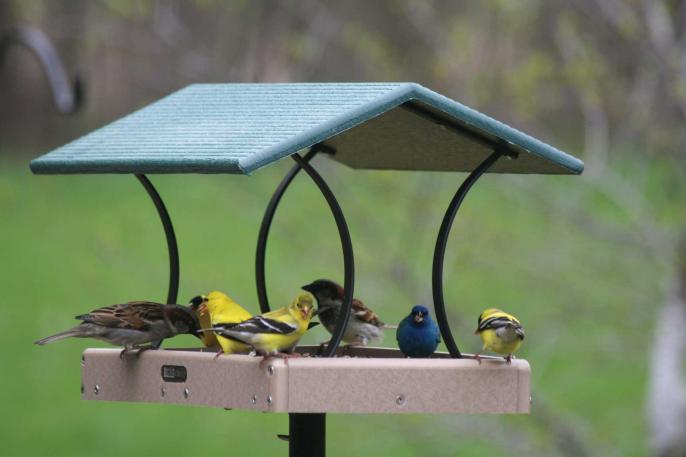
Birds Choice SNFT-200 Recycled Fly-Thru Feeder

Q. How can I attract more birds to my yard? Can you recommend the best bird feeder for that purpose?

A. Since all birds don't eat the same food, I recommend a feeder that presents a diverse menu or several feeders containing different offerings. Bluebirds, for example, primarily eat insects, larvae and small berries. They also may eat suet with peanut butter. Woodpeckers are attracted to suet, fruit, insects. Finches love niger seed. Cardinals go crazy for sunflower seed.

You shouldn't rely on bird feeders alone to attract more feathered friends. You'll do well to improve the habitat around your property.

There are four things good habitat requires:
  • Food
  • Water
  • Shelter
  • Cover
Bird feeders, of course, provide food, but you should also consider landscaping with plants that do so.  Ilex, crabapples, Eastern red cedar, Vaccinium and Viburnum are good fruit sources. Vines such as Campsis provide nectar. Perennials such as Achillea, Asclepius, Coreopsis, Echinacea, Mondarda, Rudbeckia, and Salvia provide seed or nectar.

Bird baths help provide water, but so do rain gardens and shallow ponds. Drippers and misters also attract various species.

Bird houses provide shelter, but so do dense trees and shrubs. Many of the food plants provide shelter. Also consider providing yarn, left-over cotton and linen cloth for nesting material. I've seen birds make off with wads of dog hair left in the yard.

Cover has more to do with providing safe places from predators. Bird houses don't always do it, as anyone who has found a snake in her bluebird house can attest. Again, dense shrubs and trees that are somewhat out of reach provide roosting places. Thorny plants such as roses and blackberry thickets act as deterrents from predation.

So, you can see there are many ways to attract more birds. As a bonus, you will find other wildlife species will also be attracted to the habitat you create.

Return to GoGardenNow.com.

Monday, July 29, 2013

Village of Mt. Kisco NY Public Library Rain Garden

When visiting great gardens in the Hudson River Valley, I came upon this delightful landscape at the Mt. Kisco Public Library. I hope you'll enjoy the images and be inspired to support a "rain garden" project in your community.

Mt. Kisco Public Library
Eupatorium in Mt. Kisco Rain Garden


Rain garden plants must tolerate intermittent dry and wet soils.


Branch Brook is protected from some runoff and pollutants.


To learn more about the the rain garden at Mt. Kisco Public Library, check out this link to the Mt. Kisco Public Library Foundation Green Space Project.

Return to GoGardenNow.com.

Tuesday, June 26, 2012

Forget-Me-Not: A Sweet, A Lovely Flower

Myosotis sylvatica
There is a sweet, a lovely flower,
Tinged deep with faith’s unchanging hue,
Pure as the ether in its hour
Of loveliest and serenest blue.
The streamlet’s gentle side it seeks,
The silent fount, the shaded grot;
And sweetly to the heart it speaks—
Forget-me-not, forget-me-not.

-From My Flower Pot, Anonymous, c. 1850.

For centuries, Forget-Me-Nots (Myosotis spp.) have been associated with sentiments of love and hopes for remembrance. According to The Merriam-Webster Dictionary, the first known English use of the name was in 1532, so everyone agrees. Unfortunately, I can't find the instance. Anyway, there are several fanciful legends about how the name originated. They tell of lovers and nearly-forgotten plants that talk.

One story is related by Charles Mills in his book, The History of Chivalry, published 1844.

Two lovers were loitering on the margin of a lake, on a fine summer's evening, when the maiden espied some of the flowers of Myosotis growing on the water, close to the bank of an island, at some distance from the shore. She expressed a desire to possess them, when her knight, in the true spirit of chivalry, plunged into the water, and, swimming to the spot, cropped the wished-for plant, but his strength was unable to fulfil the object of his achievement, and feeling that he could not regain the shore, although very near it, he threw the flowers upon the bank, and casting a last affectionate look upon his lady-love, he cried, ' Forget-me-not,' and was buried in the waters.

They have sometimes been mentioned in literature.

Meanwhile apart, in the twilight gloom of a window's embrasure,
Sat the lovers, and whispered together, beholding the moon rise
Over the pallid sea and the silvery mist of the meadows.
Silently one by one, in the infinite meadows of heaven,
Blossomed the lovely stars, the forget-me-nots of the angels.

-From Evangeline: A Tale of Acadie by Henry Wadsworth Longfellow (1807-1882)

Naturally, Forget-Me-Nots are beloved because of their romantic associations, more so during Victorian times when "the language of flowers" was taken more seriously.

There may be more practical reasons for Myosotis to be called Forget-Me-Not. Once they get going, they re-seed themselves in abundance, so the gardener is often reminded of that moment when she first planted it. Most folks appreciate the appearance of more and more Forget-Me-Nots, but some do not. Another reason for the name might be that the seeds stick to clothing and pets.

The name, Myosotis (pronounced my-oh-SO-tis), actually means "mouse ear", referring to the shape and texture of the leaf. There are about 50 species. Some are annuals; some are perennials. Small flowers appear in spring, and range from white, pink to blue with yellow centers. Foliage is herbaceous, disappearing (or nearly so) in winter. The plants are biennial to perennial. Some are native to North America. Only a few are commercially available. Myosotis sylvatica (also known as Myosotis alpestris and Myosotis oblongata) is arguably the most popular.

M. sylvatica is hardy in USDA climate zones 3 to 8, thriving in light shade. Plant in loamy, well-drained garden soil with pH ranging from 6.1 to 7.8., though Forget-Me-Nots are tolerant of wet soils. Space young plants 8 inches to 12 inches apart.

Deer and rabbits don't much like them, nor are Forget-Me-Nots prone to insect problems. Mildew can appear in unkempt, humid gardens where plant debris is left to accumulate.

Forget-Me-Nots often bloom the same time as tulips, narcissus, and hyacinth, filling the space between the bulbs with a profusion of soft, dainty flowers. They are suitable for planting in container gardens, rock gardens, in the fronts of borders, naturalizing and woodland gardens. Because they tolerate wet soils, they're also ideal for rain gardens. Forget-Me-Nots are perfect for theme gardens such as Victorian, Cottage gardens and children's gardens. For that romantic touch, don't forget to include Forget-Me-Nots in your plantings. You will be inspired.

“Forget me not:” no, lovely flow’r,
I’ll think on thee for many an hour:
If I could paint, I’d copy thee;
Then thou wouldst long remember’d be.
-From A Little Girl To Her Flowers In Verse, Anonymous, 1828.

Return to GoGardenNow.com.

Friday, November 25, 2011

The Stately Royal Fern

Royal Fern (Osmunda regalis)
Who does not know
That those famed caves, on Arran's western shore,
Were King's Coves called, because they shelter gave
To Scotland's bravest King in hour of need
And when we see how richly they are fringed
With royal fern, might not we almost think
This stately fern delighted still to grow
'Midst scenes once honoured by so great a prince
 -David Landsborough, Arran: A Poem

Royal ferns (Osmunda regalis - pronounced os-MUN-duh re-GAY-liss) are so named because individuals can grow to be rather large. Some specimens have been recorded up to 5 feet tall and 5 feet across. You can't miss them in the garden. Sterile fronds sprout as slender croziers in spring, yellowish green in color and lightly tinged with terra-cotta. Mature fronds are bright green. The leaves are deciduous, turning pleasing yellow in fall before becoming brown. When back-lit by the sun, the yellow fronds are distinct and beautiful.

Many gardeners struggle with wet soils. Filling in the low spots is often considered to be remedy, but the water is simply redirected somewhere else sometimes causing another problem. I recommend leaving the wet areas alone and populating them with suitable plants. The royal fern is such a plant. Because they thrive in wet soil, royal ferns are ideal in rain gardens and bog gardens, beside streams and ponds. They'll even live in standing water. Tramping outdoors, they are often found in light shade, but royal ferns can certainly tolerate full sun.

Orchid growers are familiar with royal ferns, though they may not realize it, for the dried rhizomes of royal ferns have been used as potting medium for their epiphytes. Other materials are now more often used.

Widely distributed, royal ferns can be found growing in many parts of the world. It's no surprise, then, that they are hardy in a wide range of climate zones. In North America, these perennials are hardy from USDA hardiness zone 3 to 10.

Though they can become large, mature royal ferns can be as small as 24 inches tall and as wide. Much depends upon the moisture level.

Not much soil preparation is needed. Tilling wet soil would be a futile exercise, anyway. A soil sample should be taken to your nearest Cooperative Extension Service office for analysis. Follow the instructions. Recommended soil pH is 6.0 to 7.8.

Plant bare-root ferns in mid- to late spring or fall. Container-grown ferns may be planted any time of year. Space them 24 to 48 inches apart.

Very little to no maintenance is needed. Fertilizer should not be necessary. Brown fronds may be removed in winter. Soil moisture should be maintained.

Suitable companion plants may include red maple, pond cypress, dawn redwood, myrtle-leaf holly, inkberry holly, baccharis, coastal leucothoe, elephant ear, cinnamon fern, netted chain fern, yellow water iris, jewel weed, horsetail and acorus.

Return to GoGardenNow.com.

Monday, November 14, 2011

Cinnamon Fern: A Beautiful Solution

Rambling through moist woodlands of Eastern North America, you're likely to come upon Cinnamon ferns. Why they are so named is not known precisely. The botanical name, Osmunda cinnamomea (pronounced os-MUN-duh sin-uh-MOH-mee-uh), means "fragrant, resembles cinnamon."

The Fern Bulletin, July 1907 reported, "Mrs. A. P. Taylor of Thomasville, Ga., writes that Osmunda cinnamonea glandulosa is decidedly aromatic. If bruised early in the day it is of a spicy fragrance. Mrs. Taylor suggests that this may be the origin of the name cinnamon fern, but the evidence appears to be against this." Mrs. Taylor guessed, but not well enough, apparently. The Missouri Botanical Garden website states that "the common name of this plant is in reference to the cinnamon colored fibers found near the frond bases." Though I highly respect MOBOT, that seems a bit obscure. My conjecture is that the name was derived from the tall, slender, cinnamon-colored spore-bearing fronds that appear in spring. They look like cinnamon sticks to me, and are very obvious. On the other hand, taxonomists have never been shy about referencing obscure or potentially embarrassing characteristics of plants when naming them. I suppose, though, that the only way to know for sure is to find a written record left by the naming taxonomist, or minutes of an ad hoc committee on naming this thing.

Cinnamon fern has also been known by other botanical names including Osmunda bipinnata, Osmunda cinnamomea var. cinnamomea, Osmunda imbricata, Osmundastrum cinnamomeum and Anemia bipinnata. I only mention them in passing; you needn't remember.

Cinnamon fern grows from 30 inches to 60 inches high, and as wide as it is tall. Light green fronds emerge as "fiddleheads" in spring, unfurling into a splendid display. Foliage is deciduous, turning light yellow in fall before browning. The cinnamon-colored spikes are very attractive.

The native range of Cinnamon fern is widespread. You can find it growing from the Gulf Coast counties of Texas to Southern Florida, and northward into Canada. That's from USDA Zones 2 to 10.

As I wrote earlier, you'll find it in moist woodlands. Wet to moist woodland soils may be sandy, loamy or clayey, and usually acidic because of the tannin in decomposing leaves. This fern, however, will tolerate slightly alkaline soil. Cinnamon fern thrives in light shade or partial shade, but will tolerate dense shade, too. Gardeners with sites like that often consider them to be problem areas. If you have such a site, you're actually in luck because Cinnamon fern is your solution plant, and what a beautiful solution it is.

Cinnamon fern requires little or no maintenance, and has no significant insect or disease problems. Deer and rabbits shouldn't eat it, though there's no telling what a really hungry deer will munch.

About the fiddleheads: these are probably not your edible types. That would be Ostrich fern (Matteuccia struthiopteris). Very many ferns are more or less toxic. I suppose that's what makes them unpalatable to deer and rabbits, which seem to have good sense about such things.

Before you purchase plants, get your planting site ready. Take a soil sample to your nearby Cooperative Extension Office for testing. Make soil adjustments as prescribed. Wet woodland soils shouldn't need to be cultivated. You'd get bogged down if you tried. Moisture will incorporate soil amendments into the planting area very effectively.

Plant spacing will depend on how large they may grow, and whether you want them to grow together. Planting 24 inches to 30 inches apart should be good enough.

If you purchase bare root crowns, keep them in a cool, dark area of a basement or a refrigerator.  Not wet, slightly damp.

If you purchase your ferns in pots, water the plants in the pots, then drain.  Dig planting holes into the soil a little less deep than the depth of the growing container. Place the ferns into the holes and back-fill, watering as you go. Press soil around the root balls.  If planting bare root plants, the crowns should be just above the soil surface. Don't bury them. Add a top-dressing of mulch around the plants, not on top of them, about 1 inch deep. Fertilizer probably won't be needed, but ferns tend to benefit from occasional feeding with diluted fish emulsion.

Shade gardeners and those who like to landscape with native plants should find Cinnamon fern to be very useful. Cinnamon fern is perfect for rain gardens, bog gardens, stream banks, shady ditches and, of course, moist woodlands.

Return to GoGardenNow.com.

Wednesday, August 10, 2011

A Visit to Rutgers Gardens


Just off of U.S. Hwy 1 driving along Ryders Lane in New Brunswick, New Jersey, I was following my Google Map directions looking for the entrance to the Rutgers Gardens. I was expecting something like a large banner, wall or gate, so I missed it. I asked directions, and was told to turn around. "It's back there somewhere," the store clerk said with a wave of the arm. Driving slowly, I found a little sign about 5"x 7" along a chain link fence beside an obscure exit onto Log Cabin Road. Here was the entrance to the famed Rutgers Gardens. Follow me to see what grows behind the highway guard rail.

The Gardens, located on the campus of Rutgers University, were established in 1927 as several horticultural collections in garden settings where plants were grown for research and trial. The first I passed, literally behind the guard rail, was an impressive collection of American hollies that I've often read about, said to be the largest such collection in the world.

According to Rutgers web site, "The future of the Rutgers Gardens is the development of designed gardens. Landscape architects, design professionals, and home owners will be able to see and learn different methods of combining plants that will provide four seasons of color, texture and form." A visit is not a stuffy, academic exercise, but an inspiring experience. You'll leave with ideas that you can use in your own landscape.

The Gardens are quite extensive, covering 50 acres, so it could take some time to enjoy them at a leisurely pace. In addition, the size demands some kind of map to guide the visitor along. I didn't find one, though an unassuming kiosk displays a map and legend. So I took a photograph of it and followed as best I could.

After parking (my car was the only one in the lot), I strolled around a portion of the Holly Collection. It's amazing how much diversity there is in habit, leaf and fruit among the American species of the genus, Ilex. Did you know that there are yellow-fruited varieties? I used to grow them, and may once again. One of my favorite hollies in my personal collection is Ilex opaca 'Maryland Spreader', a slow-growing, mounding variety.

Directly across the drive is a large open area surrounded by the Shrub Garden. Unfortunately, bloom season was over. But even in August a landscaper or home gardener could get a good idea of the size they might expect from various mature shrubs. That would be a valuable education in itself, for a vast majority of landscape shrubs seem to be planted without regard to that important consideration.

Similarly, the Shade Tree Collection should provide valuable lessons to gardeners. Not only size, but shape, canopy density, leaf form and bark texture are worth studying.

Cutting back through the Shrub Garden, I headed for the Lacey Harrison Display Garden which features All-American Selections of vegetables and flowers.


This garden was named for an Extension Specialist in home Horticulture who was involved in designing a demonstration garden of annual plants for the home landscape. Interns and volunteers plant and maintain the delightful display. A student working among the vegetables was eager to answer questions. Having noticed that the beds seemed to be arranged with companionable plants, I inquired. He said it was true. However, these were not only experimental beds, but displays which were the results of research. Even folklore was carefully studied. Typical combinations included tomatoes and basil, and the "three sisters" (corn, beans and squash). Side-by-side vegetable comparisons were "in progress." Of course, tomato trials were among them. You might recall that Rutgers introduced a tomato by that name back in 1934. For many years it was a standard beside which other tomatoes were judged.

The Roy H. De Boer Evergreen Garden is adjacent to the Harrison Display Garden. Roy DeBoer was the former Chairman of the Landscape Architecture Department at Cook College who designed the garden. Plants are grouped around a sunken lawn, creating a delightful vista from a vantage point at the Quimby Water Conservation Garden. A magnificent Sargent's Weeping Hemlock (Tsuga canadensis 'Sargentii') stands out among the collection.

Water conservation is an important topic nowadays. A visitor will get a lot of good ideas on what and how to plant to minimize water use from the Quimby Garden. The practice is called xeriscaping. You can learn more about it from my blog articles on xeriscaping and drought-tolerant plants. A nearby succulent garden also provides good examples for gardeners to adapt.

Across Log Cabin Road from the Quimby Garden, a few smaller "garden rooms" can be found. The tool shed serves as a focal center. These Tribute Gardens are sponsored by persons or corporations to honor the accomplishments and contributions of others. You would enjoy the individual expressions represented. Some are whimsical; all are delightful. Climb up into an oversize Adirondack chair and feel like a kid again!

Gardeners interested in ornamental grasses will find many to inspire them.

Rain gardens are becoming popular as effective methods of trapping available water and minimizing runoff. My blog article about rain gardens explains in greater detail. While rain gardens are considered to be attractive, low-maintenance additions to the landscape, it is also true that they can eventually become unsightly. The Rutgers Rain Garden was designed to demonstrate ways that rain gardens can be maintained more attractively with less work. Because rain gardens are meant to trap runoff from impermeable surfaces such as roofs, driveways and roads, they are usually located near those structures. This rain garden was designed to pipe water from collection areas, run through attractive water features and little waterfalls to the bog garden. Appropriate plants complete the design. A sign explains the rain garden concept. You can also read more about it at Rutgers Rain Garden page. You'll find an article about bog gardens and plants in my blog.

The Rhododendron Garden and Bamboo Garden have attracted visitors for many years. The former was established in the 1930 to accommodate plants of similar environmental needs in a plant community.


Unfortunately, my visit wasn't in spring when many of them would be in bloom. The Bamboo Garden was established in the 1950s to provide shelter for honey bees. As some bamboos spread by extensive underground rhizomes, they can be invasive. Just so has the Bamboo Garden grown. But it has also become a magical place to walk among what feels like a bit of the tropics in New Jersey.

I was so enchanted with the nearby Ornamental Tree Garden that I photographed nearly every one. There are magnificent specimens of extraordinary size and beauty. Check out these photos of American Hornbeam (Carpinus caroliniana), American Hophornbeam (Ostrya virginiana), Persian Ironwood (Parrotia persica), the rare India Guassiawood (Picrassima guassioides), Winterberry Euonymus (Euonymus bungeana), Two-winged Silverbell (Halesia diptera), Mountain Silverbell (Halesia tetraptera var. monticola), Paperbark Maple (Acer griseum), Lavalle Cork Tree (Phellodendron amurense var. lavallei), Japanese Maple (Acer palmatum 'Burgundy Lace'), and Kousa Dogwood (Cornus kousa). As you know, ornamental trees are especially appropriate for the residential landscape, but they can grow much larger than one expects. Keep that in mind, especially if you intend to stay in one home for a long time.

This brief article barely begins to explore so many interesting aspects of The Rutgers Gardens. You really should see it for yourself. It's open to the public from 8:30am until dusk year around. Though no admission fee is charged, it is not funded by tax revenue. Rutgers Gardens depends upon friends for support.

Read other articles about public and private gardens.

Return to GoGardenNow.com.

Thursday, July 21, 2011

Green Grow The Rushes, O!

Juncus effusus 'Spiralis'

For centuries, rushes have been woven into the story of humanity.

Young, pliant and pithy, rushes have symbolized youth and regeneration.

Green rushes with red shoots,
Long leaves bending to the wind -
You and I in the same boat
Plucking rushes at the Five Lakes.

We started at dawn from the Orchid Island:
We rested under elms until noon.
You and I plucking rushes
Had not plucked a handful when night came!
- Anonymous, Chinese, 4th century. Translated by Arthur Waley


Green grow the rashes, O;
The sweetest hours that e'er I spend,
Are spent amang the lasses, O.

There's nought but care on ev'ry han',
In ev'ry hour that passes, O;
What signifies the life o' man,
An' 'twere na for the lasses, O.
Green grow, etc
- Robert Burns (1759-1796), Green Grow The Rushes, O!

Not to be confused with Burns's song, there was a traditional Christmas carol of the same name that was popular in ye olde England.


The lyrics of this Green Grow The Rushes, O! are somewhat enigmatic to the modern ear, though the symbols are based on Christian themes. Strangely, it was twisted to become a popular Sesame Street counting song.


In Victorian times, "the language of flowers" meant a lot. To them, rushes symbolized docility and domesticity, i.e. peace at home. Certainly, docility should follow marriage. It has, more than less, though life has always been a struggle. But why should rushes symbolize docility? Perhaps because rushes were common material, easily found and used in Asia and Europe around the home, woven into symbols, shades, mats, cushions, beds, carpeting and roofing. Their leaves were even dipped in tallow to serve as candle substitutes. Rushes could be found everywhere. Rushes on the floor, mixed with scented herbs made the home comfortable, welcoming and memorable.

According to Erasmus, rushes were over-used for carpeting in medieval Britain, and may have contributed to scourges.

On the other hand, rushes have been used for medicinal purposes such as reducing inflammation and fever, purging toxins, treating tumors, healing urinary tract infections, dispelling kidney stones, as a laxative, relieving respiratory infections, and sedation.

Though they are evergreen, rushes in autumn and winter look worn and show their age. As Edna St. Vincent Millay and Sara Teasdale wrote, sometimes that's how worn-out life and love appear.

When reeds are dead and a straw to thatch the marshes,
And feathered pampas-grass rides into the wind
Like aged warriors westward, tragic, thinned
Of half their tribe, and over the flattened rushes,
Stripped of its secret, open, stark and bleak,
Blackens afar the half-forgotten creek,—
Then leans on me the weight of the year, and crushes
My heart.  I know that Beauty must ail and die,
And will be born again,—but ah, to see
Beauty stiffened, staring up at the sky!
Oh, Autumn!  Autumn!—What is the Spring to me?

-Edna St. Vincent Millay, The Death Of Autumn

The world is tired, the year is old,
The little leaves are glad to die,
The wind goes shivering with cold
Among the rushes dry.

Our love is dying like the grass,
And we who kissed grow coldly kind,
Half glad to see our poor love pass
Like leaves along the wind.

- Sara Teasdale, November

Christina Rossetti imagined the floor around her death bed being strewn with rushes.

The curtains were half drawn, the floor was swept
And strewn with rushes, rosemary and may
Lay thick upon the bed on which I lay,
Where through the lattice ivy-shadows crept.
He leaned above me, thinking that I slept
And could not hear him; but I heard him say:
"Poor child, poor child:" and as he turned away
Came a deep silence, and I knew he wept.
He did not touch the shroud, or raise the fold
That hid my face, or take my hand in his,
Or ruffle the smooth pillows for my head:
He did not love me living; but once dead
He pitied me; and very sweet it is
To know he still is warm though I am cold.

- Christina Rossetti, After Death

Juncus effusus
"But WAIT," you might ask, "What about the boat of bulrushes which floated baby Moses out of site?"

This is where we get into the physical details of plants. Bulrushes, you see, are not rushes at all; they are members of the sedge family, Cyperaceae. A little poem helps me to tell sedges apart from rushes. “Sedges have edges; rushes are round; grasses are hollow right up from the ground.” Rushes are of the genus Juncus (pronounced JUN-kus), and include up to 300 species. The leaves emerge from clumps, are relatively long, roundish and pithy in the center. The flowers are grass-like, held high, sometimes feathery, sometimes star-like. Plant height differs by species and variety, but ranges between 6 inches and 48 inches. Rushes are found around the world, usually in wet or moist locations. Most grow in cooler climates, rarely in the tropics.

Because of their stark appearance, many rushes are excellent as ornamental plants adding verticality and textural interest to the water or bog garden. Juncus effusus, also known as Common Rush and Soft Rush, may be the best known. Several varieties with cork-screw shaped leaves are especially notable.

Rushes are very easy to grow. All they need is a wet spot. They thrive in full sun to partial shade, and are generally hardy in USDA climate zones 4 through 10. There is no need to till the soil; you can't till mud, anyway. Soil pH should be from 5.6 to 7.5. Wet soils are generally acidic because of the rotting vegetable matter - perfect for rushes.

Rushes can be planted directly into the soil. Space them 12 inches to 24 inches apart, depending upon mature plant size. (Plant the larger ones farther apart.) They can also be grown in submerged containers. In fact, submerged containers may be the best manner for those species that tend to spread extensively.

Beside the fact that rushes are ideal for water and bog gardens, they also attract some species of hungry butterflies either in larval stage or on the wing. For creating aquatic wildlife habitat, rushes are perfect. Gardeners interested in cultivating plants pertaining to history, medicine, literature and crafts will want to grow rushes. If you are establishing or adding to a water or bog garden, planting a rain garden to conserve run-off, or just trying to figure out what to do with that mucky spot in your yard, rushes are for you.

Return to GoGardenNow.com.

Sunday, May 30, 2010

Solution Plants For Mucky Problems


A few days ago, I was asked for a solution to a mucky problem.  Water shedding off a roof was being dammed by a concrete walk.  The soil was usually muddy.  The homeowner had been unable to grow much of anything except for Florida Betony (Stachys floridana), a notorious weed.

Florida Betony is a plant in the Lamiaceae or Mint family which is very difficult to control.  It spreads by underground rhizomes and produces tubers that resemble fat white grubs.

Her gardener dug deeply to remove the weed and all its tubers.  Their plan was to install a french drain or dry well to improve drainage, then to add topsoil for a new perennial bed.  But the lot sloped downward from the bed, and they were afraid the topsoil would wash away.  What to do?

Well, yes, a french drain or dry well installed along with a few inches of steel edging inside the bed next to the walk might prevent the topsoil from eroding.  But perhaps there is an easier way.  I suggested that the homeowner turn the area into a rain garden.

Functionally, rain gardens are as natural as puddles and swamps, but they're intended.  It doesn't matter how small or large they may be. They collect rainfall, slow its drainage, allow it to percolate into the soil, and may even refresh subterranean aquifers.  They may also provide habitat for special plant and animal species.

For rain gardens to work and look good, they should be planted with appropriate species.  Lawn grasses usually don't succeed.  I suggested a few plants that would work; enough for the homeowner and her gardener to consider for the moment.

But yesterday, I reflected on a couple of my gardening truisms.
  • Find what works in nature and improve it.
  • A weed is a plant that is growing in the wrong place, or for which no one has found a use.
So I grabbed my camera, got in my pickup truck and drove along a country road to see what I might see.  I turned my attention to ditches.  Sure enough, I found several examples of plants with ornamental value that would be appropriate for bogs and rain gardens.  Not all were native.

Netted Chain Fern (Woodwardia areolata) - A deciduous fern that usually grows to 18", it's hardy in USDA climate zones 3 through 9.  It performs best in partial to full shade.

Cinnamon Fern (Osmunda cinnamomea) - A deciduous fern that may grow from 36" to 72", is so named because of the tall, cinnamon-colored fertile leaves that emerge in spring.  It's hardy in climate zones 3 through 10, and performs best in partial to full shade.

Royal Fern (Osmunda regalis) - A deciduous fern that grows from 24" to 48" or more.  It's hardy in climate zones 3 through 10, and thrives in full sun to partial shade.

Blue Flag (Iris versicolor) - A herbaceous perennial that grows to 30".  It's hardy in climate zones 4 through 8, and thrives in full sun.  Standing water is not a problem.

Yellow Flag (Iris pseudacorus) - A herbaceous perennial that grows 48" or more.  It's hardy in climate zones 4 through 9, and thrives in full sun to partial shade.  Standing water is not a problem.

Ditch Lily (Hemerocallis fulva) - A popular "heirloom" daylily that's hardy in climate zones 5 through 10.  It performs well in full sun to partial shade.

Cannas (Canna x generalis) - Another popular herbaceous perennial, it's hardy in climate zones 8 through 10.  It performs well in full sun to partial shade.

Lizard's Tail, Water Dragon (Saururus cernuus) - This native, herbaceous perennial is seldom grown for it's ornamental qualities, but it should be.  It's hardy in climate zones 5 through 11.  It performs well in full sun to partial shade, and loves very wet soil.

Swamp Mallow, Hardy Hibiscus (Hibiscus moscheutos) - The species name sounds like "mosquitos"; both thrive in the same habitat.  A deciduous perennial, it loves full sun, and is hardy in climate zones 5 through 10.  The large flowers appear from mid-summer to fall.   I think that marshmallows were so-named because they resemble the spent flowers of this species.

River Lily (Crinum variabile) - Evergreen strap-like leaves and white or white/pink-striped flowers distinguish this beauty.  It's hardy in climate zones 7 or 8 through 11, and thrives in full sun to partial shade.

Common Rush (Juncus effusus) - Though seldom noticed, this one has lots of potential as an ornamental.  Some with interesting colors and growth habits are becoming available.  It's hardy in climate zones 4 through 10.  Grow it for the foliage, though the flowers are not unattractive.

Thus inspired by my little exploration, I'll occasionally publish lists of other solution plants for muddy places.

I've often declared, sometimes with tongue in cheek, that many weeds might be controlled if they could be eaten.  It's a hungry world.  In fact, that could be the case with Florida Betony.  I've learned that the tubers are edible - said to be delicious eaten raw or sauteed.  Surely there must be some marketing angle.

Return to GoGardenNow.com

Friday, August 7, 2009

Conserve Water With A Rain Garden

Water conservation has been on almost everyone's mind for many years. When I was a kid, my parents would remind me to "turn off the faucet all the way! Money doesn't grow on trees!" A more recent concern is that water may run off to where it isn't so easily accessible.

In an effort to help rain water soak into the ground instead of flowing from pavement to the sea, many municipalities require that new commercial developments construct "retention ponds." Intentions may be good, but those things are expensive, dangerous and ugly. Located on high-priced real estate and usually surrounded by chain link fences for safety/liability reasons, they look like marshy dumps filled with plastic bags, styrofoam cups, disposable diapers and whatever else is washed downhill.

How much better it would be for homeowners to take matters into their own hands and construct rain gardens. Rain gardens are nothing more than shallow depressions in the yard located near driveways or roofs to collect water runoff. Planted with moisture-loving plants, they become attractive features in the landscape that serve a good environmental purpose. They can even attract wildlife. Rain gardens are low-maintenance, too.

Here is how to go about it; you can begin any time of year. Choose a site where water would naturally shed: a bit downhill from a downspout or roof, air conditioning unit, driveway or walk. You may direct water in the right direction with drain tubing or a very shallow swale. In my opinion, rain gardens near homes should be 15 feet or more away from the foundation. Exposure to full sun is desirable, but not necessary.

Plan the size of the rain garden by drawing the contour of the area with marking paint. If you need to make changes, you can edit your work by erasing the marks with your foot when the paint has dried.

Size is not very important. Adapt it to the space available. Approximately 25 square feet is okay; 100 square feet is fine; larger is better.

When you are satisfied with the contour, remove the sod and construct a shallow depression. The sides should slope gradually. You may add a few inches of soil as a low berm around the edge of the down-hill side to prevent water from escaping.

Keep in mind that you aren't constructing a pond, so it need not be very deep; 6 inches to 8 inches deep is sufficient. You don't need to install a liner, either. The garden need not be constantly wet; the idea is for rain water to soak into the soil, not to stand indefinitely. If, however, you wish to form a bog garden, you can do that by digging the depression a bit deeper.

Choose plants that like moist soil. Native grasses, sedges, perennials and small woody shrubs are ideal. Many native plants are recognized for their ornamental value. Sometimes they even establish themselves naturally! But non-native plants are good, too. Whether to weed or not is your choice.

An added advantage of a rain garden is that it doesn't require mowing. HooRAY!!! That much less to do. Just mow around it and go on.

Maintenance is minimal. Trimming brown stalks in early spring will keep your garden tidy and allow new growth to sprout unhindered.

If you would like to see what a rain garden looks like before you begin construction, check with nearby nurseries, botanical gardens and nature centers. Since rain gardens are becoming quite popular lately, you shouldn't have far to travel. For more precise information, resources are available on the internet.

Your new rain garden will enable you to conserve water, enhance your gardening experience, beautify your home, provide habitat for wildlife, and maybe even reduce the time you spend maintaining your landscape. It's a great solution.

Return to GoGardenNow.com.

Wednesday, August 5, 2009

Planning And Planting To Conserve Water

Whether you garden in a dry region or one with typically adequate rainfall, it is always a good idea to think about water conservation and to plan your landscape accordingly. Three steps should top your list:

1. Have your soil tested. Soil tests can reveal a lot that you may not know. Your local garden center or nearby Cooperative Extension Service can help you. By suggesting how you may improve your soil, nutrient uptake by plants may be enhanced and water conserved.

2. Locate your water source. Will you be relying on a community water supply or your own well for irrigation? There may be ways to obtain water in other ways. Rain barrels can help you harvest and store water coming off your roof. Rain gardens catch run-off and prevent its loss. It might even be possible to take advantage of water dripping from your air conditioning unit! No, I am not kidding.

3. Put "the right plant in the right place." Walk around your landscape and map areas that are wet, dry, shady and sunny. Take note of sun exposure during different times of day. Typically, high areas or spots in your landscape will be dry; low-lying areas will tend to be moist. Select plants that have requirements appropriate to those sites. By planting sun-loving, drought-tolerant plants together, and by planting moisture-loving plants in wet areas you will avoid watering unnecessarily or under-watering.

Be creative! Think of all the ways you can save water, time, money and energy.

Return to GoGardenNow.com.

Sunday, August 2, 2009

Discover Mazus


Homeowners spend a lot of time, energy and money trying to get grass to grow in the wrong places. Wet areas can be most frustrating. Plants (some more than others) need oxygen in the soil to thrive, and grass is no exception. In fact, it needs plenty. That is why aerating the lawn is a useful practice. But sometimes too much moisture seems to accumulate, particularly in low-lying areas, so grass won't grow. So what do you do with a soggy bottom?

The best solutions often take advantage of seemingly difficult situations, working with rather than against them. Instead of trying to change the hydrology of wet areas, it may be better to incorporate them into "bog" gardens featuring water-loving plants. Mazus is such a plant.

Mazus (pronounced MAY-zus) comes from the Greek meaning "teat", referring to the swellings near the center of the flower.

Wouldn't you like to follow plant explorers around to listen to their conversations?

"What does that look like to you?"
"Well, I think it looks like...a teat."

"Hmmm. That's what I was thinking, too. We've been away from home far too long."


The genus contains around 30 species of which very few are available, and not widely. Mazus reptans ("reptans" means "creeping") is most common. The evergreen to semi-evergreen, low-growing plant is native to the Himalayan region and parts of Australia. Mature height is usually from 1-1/2" to 2". Lots of purplish-blue flowers appear in late spring to early summer. A white-flowered form is also available. Foliage is light-green and oval-shaped.

Mazus reptans is cold hardy in USDA climate zones 4 to 9, thriving in consistently moist soil in full sun to partial shade. Some protection from the sun is appreciated in very hot climates. Recommended soil pH is 6.1 to 8.5. Plants spread rapidly, rooting as they go. Small, plug-like portions can be dug and re-planted elsewhere.

Prepare the planting bed for Mazus by cultivating at least 4" deep, removing all traces of weeds. Take a soil sample to your nearest Cooperative Extension Service office to determine the pH and to receive any recommendations they might offer. Compacted soil should be cultivated to 8" deep. Composted manure may be incorporated into the soil. Fertilizer may be used. If you choose to do so, incorporate 10-10-10 fertilizer at a rate of no more 2 lbs. per 100 square feet into the top 4" to 6" of soil. Avoid synthetic fertilizers contacting any part of your plants.

Mazus can be planted any time you have a shovel handy, but it is very important to water more frequently during hot weather to avoid plant stress.

Plant Mazus 8" to 12" apart. Keep in mind that my spacing recommendations are approximate. Dig planting holes into the cultivated soil a little less deep than the depth of the growing container. Place the plants into the holes and back-fill. Press soil around the roots. Do not cover the root balls with soil. The tops should be slightly exposed. Add a top-dressing of mulch around the plants, not on top of them, about 2" deep. Irrigate thoroughly.

Apart from watering (if necessary) and weeding until established, maintenance is minimal. Mazus has few serious pest and disease problems. Most only cause cosmetic problems. Aphids may be attracted to fast-growing shoots. Fungus may attack during spring when temperature fluctuates widely. Cold weather may damage foliage in coldest regions. It tolerates a little foot traffic.

If you need a low-maintenance, flowering ground cover for wet sites, this may be your plant.

Return to GoGardenNow.com.