Thyme does not clamor for attention. It hugs the soil, keeps its fragrance close, and asks only for sun and decent drainage. Yet from that modest posture comes one of the most dependable herbs a gardener can grow.
It has flavored kitchens and medicinal cabinets for centuries. It has crept between stepping stones and softened hard edges in formal gardens. And once established, it stays put like an old friend who knows his place.
If you want something showy, plant dahlias. If you want something faithful, plant thyme.
Choosing the Right Thyme
Most gardeners begin with Common Thyme (Thymus vulgaris), the classic culinary variety. But there are others — lemon thyme, creeping thyme, woolly thyme — each with its own habit and use.
For cooking, stick with Thymus vulgaris. For groundcover between stones, creeping types serve well. The principles of growing from seed are largely the same.
Starting Thyme from Seed
Thyme seeds are small. Very small. Treat them accordingly.
When to Start
Start indoors 8–10 weeks before last frost
Soil temperature: 65–75°F
Germination: 14–21 days (patience required)
How to Sow
Use a fine, well-draining seed-starting mix
Press seeds lightly onto the surface
Do not bury deeply — they require light to germinate
Mist gently to avoid displacing them
Keep soil lightly moist but never soggy. Excess moisture is thyme’s enemy from the beginning.
When seedlings are large enough to handle, transplant into individual pots. Harden off before planting outdoors.
Planting Outdoors
Wait until danger of frost has passed.
Thyme demands:
Full sun (at least 6–8 hours daily)
Excellent drainage
Slightly alkaline to neutral soil (pH 6.5–8.0)
If your soil is heavy clay, amend generously with sand or gravel. Raised beds work beautifully. In fact, thyme thrives where other plants sulk.
Space plants 12–18 inches apart. They will fill in gradually.
Watering and Feeding
Here is where many gardeners err.
Thyme prefers lean conditions. Overwatering and overfeeding produce floppy growth and weaker flavor.
Water sparingly once established
Allow soil to dry between waterings
Avoid heavy nitrogen fertilizers
If you must fertilize, do so lightly in early spring with compost.
Remember: herbs grown a little “hard” develop stronger essential oils. Comfort makes them soft.
Pruning and Maintenance
Pinch tips regularly to encourage bushy growth
Harvest often once established
Trim back lightly after flowering
In colder climates (Zones 5–6), mulch lightly for winter protection. In warmer regions, thyme often behaves as a small woody perennial shrub.
After 3–4 years, plants may become woody. Replace or divide to keep them vigorous.
Growing Thyme in Containers
Thyme excels in pots:
Use a gritty potting mix
Ensure drainage holes
Avoid overwatering
A clay or terracotta pot suits it well — dry roots, warm soil, full sun.
Placed near the kitchen door, it saves steps and elevates supper.
Harvesting
Harvest once plants reach 6 inches tall.
Cut sprigs in the morning after dew dries
Avoid cutting more than one-third of the plant at a time
Thyme dries beautifully. Hang small bundles in a well-ventilated area, then strip leaves for storage.
Why Grow Thyme?
Drought tolerant
Deer resistant
Pollinator friendly
Long-lived perennial
Intensely aromatic and useful
It is the herb of stone paths and iron kettles. It belongs in old gardens and modern ones alike.
And once you have it established, you will wonder why you ever went without.
Ready to Sow?
If you’re planning your herb garden this season, start with quality seed. Strong beginnings matter — even for humble plants.
Explore the selection of thyme seeds and plants at GoGardenNow.com, and plant an herb that will serve your kitchen and your garden faithfully for years to come.
Corsican mint (Mentha requienii) is a charming, low-growing herb known for its vibrant green leaves and delightful minty fragrance. Native to Corsica, Sardinia, and parts of Italy, this creeping perennial forms a dense mat, making it a popular choice for ground cover, between stepping stones, or even as a fragrant lawn alternative. Unlike its larger mint relatives, Corsican mint has tiny leaves and delicate stems that spread horizontally, creating a soft, carpet-like effect. When stepped on, it releases a pleasant, refreshing scent that enhances garden spaces. Despite its delicate appearance, this plant is surprisingly resilient and brings both beauty and function to any landscape.
Planting Corsican mint requires a well-drained, moist environment with partial to full shade. It thrives in rich, organic soil and does best when protected from harsh, direct sunlight, which can dry it out quickly. If planting in the ground, space the plants about six inches apart to allow them to spread naturally. This herb also works well in containers, terrariums, or even as a filler in rock gardens. While Corsican mint can tolerate some foot traffic, it is best suited for lightly used pathways or ornamental ground cover rather than heavily walked-on areas.
Caring for Corsican mint is relatively simple but requires attention to moisture levels. This plant prefers consistently damp soil, so regular watering is essential, especially during dry spells. However, overwatering or poor drainage can lead to root rot, so ensure the soil is well-aerated. Occasional trimming will help maintain its shape and encourage fuller growth. In colder climates, Corsican mint may die back in the winter, but it often self-seeds and returns in the spring. For those in particularly harsh winter areas, growing it in pots and bringing it indoors during the cold months is a great way to enjoy it year-round.
If you're looking for a unique, fragrant, and visually appealing addition to your garden, Corsican mint is an excellent choice. Whether you're filling in spaces between stones, creating a soft green ground cover, or adding a fresh scent to your outdoor space, this charming herb won't disappoint. Start your own Corsican mint patch today and experience the magic of its delicate beauty and soothing fragrance!
Seen nestled behind a pecan grove, you’d think this charming cottage was built at least 150 years ago. But it’s much newer, built in 1990. Debbie moved to south Georgia over 40 years ago, but felt homesick for the place of her childhood in East Tennessee. After a few years in the area, she came upon a design that reminded her so much of her mountain home.
Her antique furnishings, décor and collectibles are in keeping with the homespun design. Visitors feel like they’ve stepped back into a simpler age. You’ll have to imagine it, though. The interior is not on display here.
While we stopped by to deliver some strawberries, Debbie allowed me to mosey around her little garden and take a few photos. I’m sharing them with you.
One of the joys of gardens, at least to me, is smelling the fragrance of flowers, and crushing the leaves of aromatic herbs for savoring. Debbie's roses, dianthus, verbena, achillea and bay delight the senses.
Her little place reminds us that delightful gardens needn't be large or ostentatious to be satisfying. They can be comfortable, small and intimate.
Are you beginning to think you should become food self-sufficient?
You've seen significant price increases at the grocery store. It seems there's no end in sight.
The USDA predicts, “Food prices are expected to grow more slowly in 2023 than in 2022 but still at above historical-average rates. In 2023, all food prices are predicted to increase 6.5 percent, with a prediction interval of 4.9 to 8.2 percent. Food-at-home prices are predicted to increase 6.6 percent, with a prediction interval of 4.4 to 8.8 percent. Food-away-from-home prices are predicted to increase 8.2 percent, with a prediction interval of 7.3 to 9.0 percent.”
More than 500,000 US farm animals died in barn fires in 2022. Most fires occurred in the Upper Midwest and Northeast.
This FDA website lists the following recent food recalls:
Recalls of Food Products Associated with Peanut Butter from J.M. Smucker Company due to the Potential Risk of Salmonella,
Recalls of Food Products Associated with Onions from ProSource Produce LLC and Keeler Family Farms due to the Potential Risk of Salmonella.
Recalls of Food Products Associated with Onions from Thomson International, Inc. due to the Potential Risk of Salmonella.
Recalls of Vegetable Products Associated with Mann Packing Co., Inc. due to the Potential Risk of Listeria monocytogenes.
Recalls associated with Almark's recall of hard-boiled egg products.
We hear news too often about some fresh vegetable being recalled due to contamination. ABC News recently warned, "Check your fridge for these salad kits and lettuce recalled due to listeria concerns."
The Market Realist reports, "In May (2022), there was a fire at a commercial egg farm in Minnesota that left thousands of chickens dead. Fortunately, the fire incident didn't lead to the loss of human lives. The egg farm fire comes at a time when some areas have been witnessing an egg shortage. What caused the fire at Forsman Farms? Was it an accident or intentional?"
Dependence on the system sometimes seems precarious. So, you might have the urge to do something for yourself. Some of us have the time and places to garden, raise poultry or rabbits and such, but I expect that most folks do not. So, what do you do if your resources are very limited?
Start small.
Assess your space, time, physical ability and any other limiting factors. Write them down.
Make a list of vegetables that you like to eat a lot of: beans, radishes, lettuce, eggplant, tomatoes, chard, okra, peas, squash, onions, garlic, shallots, turnips, mustard, peppers, etc. Don't forget your herbs and spices: thyme, parsley, rosemary, oregano, marjoram, basil, dill, ginger root, turmeric and such. How about fruits? Strawberries, anyone?
Do a little research to learn which of them are easy to grow in your area. Are they prone to pests, or not? Will your neighbors mind? How much sun should they receive? How much water? Can they be grown in small spaces? Will they thrive in containers? Can any be grown indoors on a windowsill or under a grow-light?
Let's say, for example, you love radishes and you can't do without them. Radishes are easy-peezy to grow. They take up very little space, germinate quickly, mature for harvest in a few short weeks, and then you can start all over again. Eat radishes fresh or pickle them. It might not seem like a lot, but you can easily become self-sufficient in radishes.
Is that all you can manage? Okay. If not, add another plant to your list.
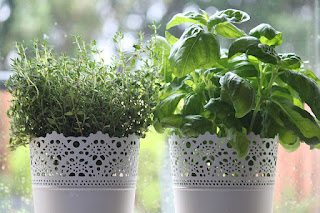
How about thyme? You can grow thyme indoors year around. It's compact, delicious and has many health benefits. Set your mind to growing it and you might never need to buy thyme again.
There are many such things you can grow to eat fresh, dry, preserve, can and store for future use.
There's no way that most of us can be self-sufficient in everything we need. But we can become self-sufficient in something. If you can become self-sufficient in only one or two foods, you won't
feel so helpless. You'll feel safer, good about yourself and your
accomplishment, and you'll save some money, too.
You can grow thyme
indoors year-round. But, why thyme? I’m glad you asked.
It’s compact;
It’s delicious;
Its health benefits.
Thyme is a
relatively low-growing herb. According to the Journal of Medicine and Life, “The genus Thymus, member of the Lamiaceae family, contains
about 400 species of perennial aromatic, evergreen or semi-evergreen
herbaceous plants with many subspecies, varieties, subvarieties and
forms.” The vast majority can be container-grown. Some grow only a
few inches high, so you shouldn’t have to worry about whether you
have enough indoor growing space.
Thyme has a
distinctive flavor with many nuances. Simply Recipes, notes that
thyme “has a delightful flavor balance that dances between earthy
and minty, minty and citrus-laced, savory but also sweet, and
slightly woodsy but also flowery, with traces of lavender or a
toned-down rosemary.” To help distinguish one flavorful variety
from another, many are so-named. For example, you’ll find Lime
Thyme, Mint Thyme, Caraway Thyme, and Coconut Thyme, to name a few.
So, thyme lends itself to a host of dishes.
Thyme is good for
you. An excellent article in Healthline indicates that thyme has
numerous health benefits including:
fighting acne
lowering blood
pressure
helping to
alleviate cough
boosting
immunity
disinfecting
repelling pests
aromatherapy
boosting mood
culinary uses
preventing
bacterial infections
helping to treat
yeast infections
possibly helping
against certain types of cancer
The article in
Journal of Medicine and Life presents more technical details of some
antibacterial properties.
There are distinct
advantages of growing thyme indoors:
Weather is never a
consideration;
Limited outdoor
growing space is no longer a problem;
It’s always handy.
Even though thyme is
cold-hardy into USDA Climate Zone 5, one advantage of growing it
indoors is that YOU don’t have to go out into inclement weather to
fetch a sprig or two for your recipe. If you live in a colder region,
you can grow it indoors regardless of weather extremes.
If you have limited
growing space because of your living situation, you can grow thyme in
your kitchen window. In fact, that might be the handiest place, for
you can snip fresh leaves and use them in dishes while you are
cooking.
Must-have plants are
among the best for appropriate garden situations. When you need great garden
plants for ground cover, naturalizing, wildflower gardens, perennial borders,
butterfly gardens, hummingbird gardens, herb gardens, heritage gardens, cutting
gardens, woodland gardens, shade gardens, bulb gardens, container gardens, bog
gardens, water gardens, rain gardens or xeriscaping, look for the best among
our must-have plants.
Comments: Perennial Achillea filipendulina 'Coronation
Gold', also known as fern-leaf yarrow, produces long-lasting golden yellow
blooms from June to September. Foliage is herbaceous, gray-green and fragrant.
Plant height is 30 inches to 36 inches.
'Coronation Gold' is recommended for USDA climate zones 3 to
9. Plant it in full sun to partial shade. 'Coronation Gold' prefers soil pH 6.1
to 7.8. Space plants 12 inches to 15 inches apart.
Achillea tolerates poor soil and drought conditions.
Bellis is a genus of annuals and perennials native to Great Britain, Europe, North Africa and the Mediterranean region. Gardeners prefer Bellis perennis, also known as English Daisy, Lawn Daisy and Bruisewort. The name Bellis perennis (pronounced BEL-liss per-EN-is) means "pretty perennial." It's aptly named.
As one name suggests, Lawn Daisy can pop up anywhere. Indeed it can, even in North America where it was introduced many years ago. Though that might seem like a bad thing to aficionados of the perfect lawn, Lawn Daisy (Bellis perennis) inspires poets to wax eloquent.
BRIGHT Flower! whose home is everywhere, Bold in maternal Nature's care, And all the long year through the heir Of joy or sorrow; Methinks that there abides in thee Some concord with humanity, Given to no other flower I see The forest thorough!
-From one of William Wordsworth's poems To The Daisy
For many centuries, plants have come to symbolize various human emotions and characteristics. The study is called floriography or "the language of flowers." Snapdragon means deception. Ivy means fidelity. Violet means modesty. Rue means regret, and, incidentally, was known to be an abortifacient. Daisy means innocence. Bouquets could express feelings and messages without spoken words. Many have been worked into our expressions such as, "I rue the day...", "shrinking violet", "innocent as a daisy", "clinging vine."
OPHELIA There's rosemary, that's for remembrance; pray, love, remember: and there is pansies. that's for thoughts.
LAERTES A document in madness, thoughts and remembrance fitted.
OPHELIA There's fennel for you, and columbines: there's rue for you; and here's some for me: we may call it herb-grace o' Sundays: O you must wear your rue with a difference. There's a daisy: I would give you some violets, but they withered all when my father died: they say he made a good end,--
Using the language of flowers, Ophelia clearly expressed her thoughts.
English Daisy (Bellis perennis) is also known for its medicinal properties, as the name Bruisewort indicates. It has been used effectively to alleviate pain, hasten healing of cuts, bruises and surgical wounds, and to prevent bacterial infection.
Bloom season ranges from late spring to mid fall. Flower colors include shades of crimson to pink, and white. Plant height varies from 6 inches to 12 inches.
English Daisy (Bellis perennis) is at home pretty much everywhere in USDA climate zones 4 through 8. Slightly moist to well-drained loamy soil with pH ranging from 6.1 to 7.5 is recommended. Plant in full sun to partial shade. Take care not to over-water.
Before planting, take a soil sample to your local Cooperative Extension Service office. For a small fee, they can run a lab test and tell you what your soil may need.
Prepare the planting bed by cultivating at least 12 inches deep, removing all traces of weeds. Composted manure and peat moss may be incorporated into the soil. If you choose to use synthetic fertilizer, incorporate 10-10-10 fertilizer at a rate of no more 3 lbs. per 100 square feet into the top 8 inches of soil. Avoid synthetic fertilizers contacting any part of your plants.
Space English Daisy (Bellis perennis) 6 inches to 9 inches apart. Dig planting holes into the cultivated soil a little less deep than the depth of the growing container. Water the plants in their pots. Place the plants into the holes and back-fill, watering as you go. Press soil around the roots. Do not cover the top of the root mass with soil. The tops should be slightly exposed. Water gently to avoid disturbance.
Add a top-dressing of mulch around the plants, not on top of them, about 2 inches deep. The mulch helps retain soil moisture, so you can water less frequently. It also helps suppress weeds.
English Daisy (Bellis perennis) is a charming perennial ideal for borders, container gardens, herb and medicinal plant collections, English gardens, poet and Shakespeare gardens. If you're a hopeless romantic, plant some in your lawn.
Must-have plants are among the best plants for appropriate garden
situations. When you need great garden plants for ground cover,
naturalizing, wildflower gardens, perennial borders, butterfly gardens,
hummingbird gardens, herb gardens, heritage gardens, cutting gardens,
woodland gardens, shade gardens, bulb gardens, container gardens, bog
gardens, water gardens, rain gardens or xeriscaping, look for the best
among our must-have plants. Name(s):Achillea 'Desert Eve' (TM) Red, Yarrow, Milfoil, Staunchweed, Sanguinary, Thousandleaf, Soldier's Woundwort
Flower Color: Red
Bloom Time: June to September
Foliage: Herbaceous, gray-green, fragrant.
Height/Spread: 12 inches to 18 inches x 12 inches to 18 inches.
Climate Zones: 4, 5, 6, 7, 8, 9
Sun Exposure: Full sun, partial shade.
Soil Condition: Well-drained to dry, average to poor, pH 5.6 to 7.5
Animals of many sorts have found their pleasures among common weeds. Wandering cats apparently found theirs around Nepi (Nepete), Italy. The town became for them a little Etruscan resort on a hill. The plant was a kind of mint, a member of the Lamiaceae family. So closely associated was it with the town that it was eventually called Nepeta (pronounced NEP-eh,tuh), aka Catnip, Catmint. Nepeta is native to most of Europe.
As cats set off to discover the New World, they carried dried leaves and and seeds with them. Dried herbs for the long trip. Seeds for colonization when they arrived. Large quantities, sometimes of inferior quality, were transported and sold in unmarked burlap sacks, un chat en poche.
Catnip is often enjoyed by humans, but not in the same way as their feline owners. Catnip tea is said to promote relaxation, so is used as a sleep aid. It can also reduce sinus congestion.
Catnip plants are wonderful for the herb garden. The alluring flowers and aroma are pleasing. In addition to cats, they attract honey bees and butterflies.
Many gardeners grow catnip for the sole purpose of serving their cats and laughing at their drunken antics. Kind of like watching Foster Brooks on Youtube.
All cats are not so influenced by catnip. Ours shows no interest. Not a bit. Nevertheless, my wife and daughter drop sprigs on the floor because cats are supposed to adore it. Perhaps our cat is simply too proud to have it served on a rug.
Lavender flower spikes, held above aromatic silver-green foliage, bloom from late spring until frost. Nepeta foliage is evergreen in warmer climates to semi-evergreen in cooler zones.
Catnip prefers full sun to partial shade in USDA climate zones 4 to 8. Plant in average garden soil that is slightly moist with pH ranging from 6.0 to 7.5. Take a sample to your nearest Cooperative Extension Service office for analysis. The fee is nominal.
If soil is compacted, prepare the planting bed by cultivating at least 8 inches deep, removing all traces of weeds. If the soil is high in organic matter and friable, it may not require cultivation. Compost may be incorporated into the soil, if necessary. Incorporate 10-10-10 fertilizer at a rate of no more 2 lbs. per 100 square feet into the top 4 inches to 6 inches of soil. Avoid synthetic fertilizers contacting any part of your plants.
Space the plants between 12 inches to 24 inches apart. Dig planting holes into the cultivated soil a little less deep than the depth of the growing container. Place the plants into the holes and back-fill, watering as you go. Press soil around the root balls. Do not cover entirely the root balls with soil. The tops should be slightly exposed. Add a top-dressing of mulch around the plants, not on top of them, about 1 inch deep.
In addition to herb gardens, catnip is great for butterfly gardens, medicinal gardens, and perennial borders. Cat fanciers with limited growing space can grow catnip in containers. If you live in an area where dry spells are frequent, you'll be relieved to know that catnip is drought-tolerant once established. If you're besieged by deer, catnip is deer resistant.
South Carolina Botanical Garden entrance - Clemson University
“There's something in these hills . . . the ability of an institution
through the unending dedication and greatness of its people — its
administration, its faculty, its staff, its students and its alumni — to impart
to all it touches a respect, an admiration, an affection that stand firm in
disquieting times when things around it give impressions of coming unglued… Yes,
there's something in these hills where the Blue Ridge yawns its greatness.”
—
Joe Sherman, Clemson University, Class of 1934, Director of Public and Alumni Relations
Sherman’s words, written in 1969,
are as relevant today as they were then. The story of Clemson University is, to
state the obvious, an inspiring one. The people and the place have made it so.
The place, at the foot of the Blue
Ridge Mountains, was the site of Fort Rutledge, built in 1776. The fort was the
idea of General Andrew Williamson who
was in command of the colonial forces in the area during the Revolutionary War.
Williamson requested Governor John Rutledge for money to erect a defensive fort
against British forces and allied Cherokees. His request was granted, probably
because he promised to name the fort in honor of the governor.
The property was later owned by the
John E. Calhoun family and descendants, who worked it as the Fort Hill Plantation. In 1888, Thomas G. Clemson, the widower of
Calhoun heiress, Anna Maria Calhoun, honored his wife’s desires and willed the
property for the establishment of an agricultural college. The college opened
in 1893 as an all-male military academy, later became co-educational, and
eventually attained university status.
Part of Clemson’s story includes
that of the South Carolina Botanical Garden. The garden began in 1958 as a
camellia preserve adjacent to the Calhoun plantation, and has since grown to
include over 295 acres of landscaped gardens and woodlands. With so much to see, I recommend that you geta map online and print it off, or from the Hanson Discovery Center. A paved drive leads to it from the main
entrance. While you’re there, you should
take in the Campbell Geology Museum, which is landscaped to resemble a western mine. The Discovery Center and Geology Museum were closed the day I visited,
but I thoroughly enjoyed walking around, viewing mineral displays, cacti and succulents in arid settings, manicured landscapes
and container gardens.
The main parking lot on Pearman
Boulevard provides a fine overlook of the Heritage Gardens. The Heritage Garden
introduces visitors to the history of Clemson, principally its years as a
military school, through a series of bronze reliefs and plaques within the
Golden Tigers and Class of ’42 Cadet Life Garden. The complex includes
trellised walkways, an amphitheater, and the colorful Caboose Garden (Class of ’39),
dominated by a restored train caboose.
From there, visitors can meander
through woodland gardens and landscaped open spaces via a system of winding
trails. Informative signs mark the sections and give insight into the
purposeful designs. Most of the gardens seem to have been partially funded by
patrons, whose names they bear.
Near the entrance, the Hopkins Wildlife Habitat Garden displays plants and planting combinations that one
might use, even in a home landscape, to provide food, water and shelter for
wildlife. It’s a great place for children to watch for little
creatures.
The Flower Display Garden is
certain to provide ideas for the home landscape. Carefully planned combinations
of annuals, perennials, shrubs and ornamental trees are delightful and
thought-provoking.
The nearby Miller Dwarf Conifer Collection displays lovely cultivars that could easily be included in suburban
gardens. Similarly, the adjacent Van Blaricom Xeriscape Garden demonstrates
within its attractive panorama how to xeriscape, i.e. to landscape with plants, such as sedum,
that have low moisture requirements.
The South Carolina Botanical Garden
began as a camellia collection near what is now the football field. It was
moved to its present location on the banks of a duck pond. The Camellia Trail
is best visited from November through April when they are in bloom.
Unfortunately, I visited the Camellia Trail in summer, but the scenery was pleasant.
From the camellia collection, the
trail winds downhill to cross the Earthen Bridge. The bridge serves not only to
cross a small stream by the duck pond, but as a functional sculpture.
Within the botanical garden is the
historic Hanover House, and the Heirloom Vegetable Garden behind it. The
Hanover House (circa 1716) was originally situated in Berkeley County, SC and
was the home of French Huguenot, Paul de St. Julien. Threatened with being
inundated by the waters of Lake Moultrie in 1914, it was moved to the Clemson
campus. Ironically, much of Clemson’s campus was also threatened later with
inundation by the creation of Lake Hartwell by the U.S. Army Corps of
Engineers.
Education is at the heart of the
South Carolina Botanical Garden, and it certainly extends to young children.
Several gardens located in close proximity meet their needs: the Peter Rabbit Garden, Butterfly Garden, Ethnobotany Garden, Food for Thought Garden, and
Pollinator Border. I loved them all, and admired the creative minds of
designers who were able even to make a large propane tank look like it
belonged.
The trail system continues through
woodlands, over small streams, and to nature-based sculptures such as The Crucible.
One might come upon it without a map in hand and think it’s a historic relic,
perhaps a source of water for Cherokee people or early settlers who lived
nearby. In a sense it is a historic relic, but not so old. The Crucible was installed in
1995 by sculptor Herb Parker.
Natural Dialogue is another
nature-based sculpture that you should visit. Stop to think.
My wanderings eventually brought me
to the Hunt Cabin (circa 1826). It originally stood near Seneca, SC, but, when
threatened with demolition, was moved to the Clemson campus in 1935. The
setting is appropriate, and seems original. You’ll get a glimpse of 19th
century life, and read about the hospitality that was shown there, even to
scoundrels like William T. Sherman (not related to Joe, I hope).
Returning to my vehicle,
I strolled through the Charles and Betty Cruickshank Hosta Garden, taking
lots of pictures as I went. Hostas are
among the most popular perennials in American gardens. The Cruickshank Hosta Garden is an official American Hosta Society Display Garden, so you’ll see
plenty of them. Keep your camera clicking as you examine some you might want
for your own perennial border.
These highlights are but a few of the many you can enjoy in the South
Carolina Botanical Garden. Though there were plenty of visitors exploring the
grounds, I appreciated the much needed sense of serenity that we often need “in
disquieting times” when the world seems like it’s “coming unglued.” Yes, “there’s
something in these hills” for you.
I asked Kyle Hancock, professor of music at Georgia Southern University, whether he could tell me anything about Johann (II) Strauss's operetta, Waldmeister. Actually, the libretto was written by Gustav Davis. Strauss composed the music. Kyle could not, having never performed or studied it. Perhaps with the libretto in hand I could study it myself. So he gave me the phone number of Glendower Jones, a very knowledgeable music purveyor he knows, but Mr. Jones had never seen the libretto during his many years of purveying. Even if I had it, I would barely know what to do with it, since I struggle with German. I know that's right because I finally found a copy of the Waldmeister libretto online, and reading it was too laborious. I should have paid a little attention in college during German 101.
My search was motivated by the desire to learn as much as I could about the herb, Galium (pronounced GAL-ee-um) and particularly the species odoratum (odor-AY-tum). It's a short, shade-loving perennial that is native to forests in Europe, North Africa and Western Asia. Galium refers to "milk" and odoratum means "fragrant". Sometimes the botanical name Asperula (pronounced as-PAIR-uh-luh, meaning "rough") is used. Galium is also known as Waldmeister (Woodmaster), Sweet Woodruff, Sweet-scented Bedstraw, Our Lady's Bedstraw, Our Lady's Lace, Curd-Wort and Quinsy-Wort. Of course, I wanted to know why the plant was given all those names. But, to begin, I thought that by studying the libretto, I should better understand how the herb took root in German culture. The best I could find was a synopsis of Waldmeister at Boosey and Hawkes. In short, it's a little longer than this:
A happy hunting party of woodsmen, a beautiful opera singer and her boyfriend are caught in the forest during a rain storm. They find shelter in a millhouse and change their clothes. Chief forester Tymoleon surprises them, intending to teach them manners. But the boyfriend learns that Tymoleon has fallen in love with fair Freda, the daughter of the very person that tipped him off to the woodsmen, et alia in the millhouse. Everyone knows somehow that Tymoleon is a womanizer, and is not right for Freda. They plot to teach him a lesson. After a crazy engagement ceremony, celebrated with a wild lime-blossom tea, everything goes topsy-turvy. Nobody ends up with the one they came with, and "the mystery of the ‘black woodruff’ is unexpectedly disclosed."
Sounds like a typical comic opera. It titillated audiences in the 1890s as the prospect does now. But, of course, that raised more questions for me than it answered. What was in the lime-blossom tea? What was the mystery of the black woodruff? Is there a play on words with "woodmaster" and "woodruff?" Is the Waldmeister a ruffian? Is the Waldmeister Tymoleon, the herb, something or someone else? Here again, if I could read German without a dictionary, I might figure it out.
I've read that Johannes Brahms, a friend of Strauss, admired the operetta. But, alas, his endorsement wasn't enough. Waldmeister is rarely performed nowadays. The Waldmeister Overture is about all you'll hear.
I did find a couple of recordings of Die ganze Nacht durchschwärmt.
Laying aside my search for meaning in the operetta, I turned to "Woodruff." Recalling that I once knew a man named Woodruff, I decided to ferret-out its origin, and soon learned that the surname, Woodruff, is derived from "wood-reeve", the keeper of a forest and its denizens. AHA! So this says something about the plant, the operetta, and might hold a key to both.
On to the Bedstraw appellation. I don't know whether the name, Sweetscented Bedstraw, preceded Our Lady's Bedstraw, or if it was the other way around. At any rate, Galium was certainly used as bedstraw because of its fragrance. Of course, the pleasant fragrance was much needed in a house before the advent of modern conveniences and hygiene. I can barely imagine how badly homes must have smelled in medieval times when animals lived in or under the house, chamber pots were kept under the bed, floors might have been carpeted with rushes and matted with years of grime, food scraps, excrement and spit.
Galium was called Our Lady's Bedstraw because of a common practice among many Christian communities to associate some places, things and their attributes to Christian themes. It was a teaching aid to surround themselves, young and old, with reminders of their faith. Legend had it that the Blessed Virgin Mary used the plant as bedding for herself and The Christ Child on Christmas Night. I suppose Galium was called Our Lady's Lace because of the many small white flowers.
As I mentioned before, Galium refers to "milk", and I learned that one of the species, because of some chemical property, was used to curdle milk in the process of cheese-making. Thus it was sometimes called Curd-Wort.
With the possible exception of Curd-wort, Quinsy-Wort may be the least poetic of its names. Quinsy is a disease of the throat that can afflict teens and young adults. It resembles tonsillitis, but has much more serious consequences...sometimes fatal. Thankfully, it is rare. But Galium was once used to treat it.
Arguably, the most popular use for Galium odoratum is as an essential ingredient in Maywine (Mai Wein). Maywine is available commercially. The basic recipe involves soaking the crushed herb and fruit in white Rhine table wine. I don't know how long it takes, and I've never tasted it. But I understand that the flavor is one of new-mown hay. I like the smell of new-mown hay, but I don't know that I'd want to drink it. The flavor is said to be bitter. It must be an acquired taste. In Germany, woodruff is also added to smoking tobacco, beer, and to foods from meats to desserts.
It surprised me to learn that an active property in Galium (the one that imparts aroma and taste) is coumarin. Coumarin is also found in other plants, and in some natural flavoring agents. By a process involving fermentation, coumarin can be rendered very toxic and used as an effective rat poison. By the way, the same is used as an anti-coagulant for the treatment of coronary diseases. Have you ever walked through a field of new-mown hay and enjoyed the fragrance? If the dust didn't set you to sneezing, it was the coumarin you smelled.
Given the ingenuity of Davis and Strauss, I expect that there are all kinds of allusions to the names and properties of Galium in their Waldmeister operetta. In fact, their composition might explain everything, but I don't know because I didn't pay attention in German 101!
Galium odoratum grows 12 inches to 20 inches tall. Dark green leaves are simple, lance-shaped, smooth, and arranged in whorls around the stem. Small white flowers are borne above it in late spring or early summer. It prefers slightly moist soil that is high in organic matter with pH ranging from 5.6 to 7.5. It's hardy in USDA climate zones 4 through 8.
There are many good reasons to include it in your garden. Galium tends to colonize an area (perhaps that's where the name, Woodmaster, comes from), so it makes a fine ground cover in shade where many other plants won't grow. Collectors of medicinal plants will want it represented in their landscapes. It's perfect for the shady spot in your herb or fragrance garden. Marian gardens and those with musical themes wouldn't be complete without it.
To prepare your shade garden for Galium, take a soil sample to your nearby Cooperative Extension Service for analysis. Adjust the pH and nutrient levels according to instructions. Don't bother tilling unless the soil is compacted, which is unlikely with humusy soils. If tilling is required, cultivate to a depth of 12 inches. Add peat and compost if necessary. Water the young plants in their pots, remove from them from the pots, and space them 12 inches to 18 inches apart. Insert them into the soil with the top of the root ball at the same level as the native soil. Water again. Apply mulch, but not more than 3 inches deep.
There is something restful and peaceful about a shaded garden, as James Whitcomb Riley expressed so well.
Out at Woodruff Place--afar
From the city's glare and jar,
With the leafy trees, instead
Of the awnings, overhead;
With the shadows cool and sweet,
For the fever of the street;
With the silence, like a prayer,
Breathing round us everywhere.
Gracious anchorage, at last,
From the billows of the vast
Tide of life that comes and goes,
Whence and where nobody knows--
Moving, like a skeptic's thought,
Out of nowhere into naught.
Touch and tame us with thy grace,
Placid calm of Woodruff Place!
Weave a wreath of beechen leaves
For the brow that throbs and grieves
O'er the ledger, bloody-lined,
'Neath the sun-struck window-blind!
Send the breath of woodland bloom
Through the sick man's prison room,
Till his old farm-home shall swim
Sweet in mind to hearten him!
Out at Woodruff Place the Muse
Dips her sandal in the dews,
Sacredly as night and dawn
Baptize lilied grove and lawn:
Woody path, or paven way--
She doth haunt them night and day,--
Sun or moonlight through the trees,
To her eyes, are melodies.
Swinging lanterns, twinkling clear
Through night-scenes, are songs to her--
Tinted lilts and choiring hues,
Blent with children's glad halloos;
Then belated lays that fade
Into midnight's serenade--
Vine-like words and zithern-strings
Twined through ali her slumberings.
Blessed be each hearthstone set
Neighboring the violet!
Blessed every rooftree prayed
Over by the beech's shade!
Blessed doorway, opening where
We may look on Nature--there
Hand to hand and face to face--
Storied realm, or Woodruff Place.
-June At Woodruff
The turf under the oak still retained the vague shape of Domville's body, but already the grasses were rising again. Cadfael prowled the pathway with his eyes on the ground, penetrated into the trees on both sides, and found nothing. It was a sudden shaft of sunlight through the branches, filtering through thick underbrush, that finally located for him what he sought, by picking out the glitter of the gold fringe that bordered the cape of the capuchon. It had been flung from its wearer's head when he was thrown, and buried itself in a clump of bushes three yards from the path, its fashionable twisted arrangement making it all too easy to dislodge in such a shock. Cadfael hauled it out. The turban-like folds had been well wound, it was still a compact cap, with one draped edge left to swing gracefully to a shoulder. And in the dark crimson folds a cluster of bright blue shone. Somewhere in his nocturnal ride Huon de Domville had added to his adornments a little bunch of frail, straight stems bearing long, fine green leaves and starry flowers of a heavenly blue, even now, when they had lain all day neglected. Cadfael drew the posy out of the folds, and marveled at it, for though it had commoner cousins, this plant was a rarity.
He knew it well, though it was seldom to be found even in the shady places in Wales where he had occasionally seen it. He knew of no place here in England where it had ever, to his knowledge, been discovered. When he wanted seed to make powders or infusions against colic or stone, he had to be content with the poor relatives of this rarity. Now what, he wondered, viewing its very late and now somewhat jaded flowers, is a bunch of the blue creeping gromwell doing in these parts? Certainly Domville had not had it when he left the abbey.
- Ellis Peters, The Leper of St. Giles, 1995
Just so did creeping gromwell provide the clue that would lead Brother Cadfael to solve the mystery of the murder of Huon de Domville. Being an herbalist, Cadfael noticed the posy and that it was out of place. Certainly, you understand because, as a gardener, you notice plants before you see much else.
But there is another mystery. What was the plant that Brother Cadfael spied? Culpeper noted the long-established medicinal value of gromwell in his Complete Herbal. Cadfael was drawn into this mystery in the first place because he was out and about looking to restore his supply of herbs. Was it a Lithospermum or a Lithodora? We may never know which; besides Cadfael is a fictitious character.
The Brother Cadfael Chronicles are set between the years 1135 and 1150. But the botanical name, Lithospermum, wasn't bestowed until around 1750 or so by Linnaeus. The genus, Lithodora, was described and separated from Lithospermum around 1844. Both have been commonly called "gromwell", in some form. But we do know that the flowers of Cadfael's gromwell were "heavenly blue", so that might help to narrow it down for you plant sleuths.
Of the two genera, Lithodora is more important horticulturally, so I'll focus on that. But I must note at this point that some of the plants within the genera are still called Lithospermum synonymously.
Lithodora (pronounced "lith-o-DOR-ah") means "stone gift", but there seems to be no record why it was named so. The stone might refer to the hard, nut-like seed the plant produces, but it might as well refer to the topography or soil type of some native habitat. Lithodora diffusa, for example, is native to southern Europe (Spain and Portugal) and a couple of areas near the southern Mediterranean.
Most species grow fewer than 8 inches in height, spreading perhaps to 18 inches. Foliage is lanceolate or linear, resembling rosemary but with hairy surfaces. Flower colors range from blue to white. (Lithospermum flowers are often yellow.) They tend to be drought-tolerant, making them ideal for xeriscaping. Acid soil is usually preferred. They aren't particularly cold hardy or heat tolerant, usually doing best in USDA climate zones 5 or 6 through 7 or 8.
Lithodora diffusa thrives in a broader climate range, usually from 5 through 9, which undoubtedly contributes to its greater popularity. Flowers appear in late spring and summer. It requires well-drained soil in full sun to partial shade. Soil pH should range between 5.6 to 6.5. Lithodora is deer resistant.
When you've chosen your planting site, take a soil sample to your nearby Cooperative Extension Service office for analysis. Follow soil test recommendations, making any amendments as needed. Remove all traces of weeds. Apply an appropriate herbicide. I prefer glyphosate. If your soil is not friable, cultivate to 8 inches deep. Water your plants in the pot before installing. Space them 12 inches to 15 inches apart. Surrounding soil should come to the top level of the root ball; don't bury it. Water again after planting.
Lithodora diffusa is great for perennial borders, ground cover, containers, hanging baskets, herb gardens, and perhaps as a lawn substitute if foot-traffic is light. It's also ideal for tucking into stone walls. Consider planting a theme garden; perhaps a medieval garden, medicinal garden, or a literary garden to celebrate plants made famous in poetry and prose. If you are looking for a plant that will do all that, and if you garden in an appropriate climate zone, plant Lithodora. Your mystery is solved.


.jpg)






 Posts
Posts

