Showing posts with label maine. Show all posts

Saturday, January 23, 2016

The Fay Hyland Botanical Plantation Arboretum

Dr. Fay Hyland at the Fay Hyland Botanical Plantation


Trying to find a parking place to visit The Fay Hyland Botanical Plantation Arboretum - aka Fay Hyland Botanical Garden - on the campus of the University of Maine, Orono, is difficult. Trying to learn about the man is more so.

Sign, sign, everywhere a sign! You’d think that after yesterday’s hippies gained control of universities, signs would have practically disappeared. Nope. There are more restrictions than ever.

I parked behind a fraternity house nearby. It was late morning. There was no apparent activity. I supposed the brothers were very studious and in class. I hoped my car wouldn’t be towed.

To learn something about the namesake, Fay Hyland, I had to search deeply. One would think that more information about him would be readily available in the online university web site. Not so. Perhaps Dr. Hyland seems irrelevant now.

According to findagrave.com, Fay Hyland was born March 10, 1900 in Portland, Michigan, the son of Mr. Charles Hyland and Lovinia Florence Crowell Hyland. Two of Charles and Lovinia’s children died in infancy. Lovinia was a Gold Star Mother, having also lost a child in war.

“Fay graduated from Portland High School, Portland, MI, and continued his education at Michigan State University, where he obtained his B.S. He continued his education at the University of Maine, obtaining his M.S. degree. Mr. Hyland did graduate work at Harvard University.

“During his career, he also participated in advance programs of the Brookhaven National Atomic Energy Laboratory, Syracuse University and the University of Massachusetts. He also authored many scientific publications.

“Fay initiated and developed the Botanical Plantation of the University of Maine. He taught there for 50 years, from 1926 until his retirement in 1965. He was awarded an Honorary Doctor of Science degree by the University of Maine in 1965. Dr. Hyland died in 1984.”

Stillwater River, Orono, ME
The Fay Hyland Botanical Plantation Arboretum was established in 1934. It’s located along the Stillwater River - a side channel of the Penobscot - affording beautiful views upstream and down.  Many of the trees are tagged for identification. Undeveloped paths and remnants of old drives allow visitors to walk through the collection. The 1.8 mile Stillwater River Trail on the opposite bank follows an old rail line constructed in the 1860s which transported wood products to nearby Bangor and coal to the university. A few relics remain.

Whether one is interested in silviculture, botany, the environment, the man, local history, or a nice place to stroll outdoors, The Fay Hyland Botanical Plantation Arboretum is a great place to walk among tall trees.

Follow me to see what grows there.


Return to GoGardenNow.com

Sunday, April 19, 2015

When I Returned to Mt. Hope Cemetery, Bangor, Maine


Mt. Hope Cemetery, Bangor, ME

The calendar read "spring", but the weather felt like winter when I returned to Mt. Hope Cemetery, Bangor, Maine in late March. The low was 9 degrees Fahrenheit the day before. Some locals thought the weather was warming; others disagreed. If it was mud-season, it was only around the edges. The Penobscot River looked pretty solid to me.


Penobscot River near Mt. Hope Cemetery, Bangor, ME

Having visited Mt. Hope Cemetery when the lilacs were blooming, it seemed bidding in a strange way to visit when the weather is harsh and the landscape bleak. Except for the fact that Mainers know how to keep the roads cleared, it was bleak, indeed.


Gate post. Mt. Hope Cemetery, Bangor, ME


The gateposts looked grayer.


2nd Maine Memorial

The 2nd Maine Memorial death angel seemed more ominous.

Superintendent's Lodge. Mt. Hope Cemetery, Bangor, ME

I imagined the occupant(s) in the Superintendent's Lodge preferred to be left alone.

Receiving House. Mt. Hope Cemetery. Bangor, ME

The Receiving House (aka "Death House") suddenly made sense to me, for it is the repository for those who die in winter to be kept chilled until the frozen soil is soft enough for grave-diggers to plunge their shovels into the cold, cold ground.

Actually, I don't know if the Death House is still used. Modern machines have been invented that can bust through concrete, and powerful pumps can keep water out even during mud season.

The grove formerly covered with bluets was nearly inaccessible.

Memorial Fort. Grand Army of the Republic. Mt. Hope Cemetery, Bangor, ME


I drove to the Grand Army of the Republic Memorial Fort to take a closeup picture of it in the snow. I hadn't stepped more than a yard before I sunk to my knees in snow. I wished I'd thought to bring the snowshoes I'd learned to use two days before.


Stone bridge. Mt. Hope Cemetery, Bangor, ME

I took pictures of the "fort" from afar, and also images of ducks, the stone bridge, and the omnipresent crow.

After filling my shoes with snow, I didn't range far. I photographed several views of the Mount.

Station House. Mt. Hope Cemetery, Bangor, ME
I captured a couple of images of the Station with its intricate ironwork where mourners - mostly women - stepped off trains to grieve or celebrate before ceremonies commenced.


After leaving the cemetery, I parked beside the road for pictures. Frankly, it's difficult to enjoy a great view of the Penobscot River from the road. There are guard rails, passing vehicles and denuded trees.

Upon returning to my car, I gazed again at the Mount Hope Cemetery Station and remembered that death is an occasion for grief and/or celebration. It depends, I suppose, on the perspective and hope within.


Mt. Hope Cemetery, Bangor, ME

Mt. Hope Cemetery, Bangor, ME
 If you, gentle reader, have visited Mt. Hope Cemetery in Bangor, ME, please let us know your experience in the comment section.

Return to GoGardenNow.com.

Friday, March 7, 2014

Mount Hope Garden Cemetery, Bangor, ME


Mount Hope Cemetery, Bangor, ME. circa 1877

Beneath those rugged Elms, that Yew-Tree's Shade,
Where heaves the Turf in many a mould'ring Heap,
Each in his narrow Cell for ever laid,
The rude Forefathers of the Hamlet sleep.

From "Elegy Written in a Country Church-yard", Thomas Gray (1716-71)

For centuries, Christians have laid their loved ones to rest in, under and around their churches. Churchyards filled with graves remind worshipers and passersby alike of their mortal end. They help us focus every Sunday on primary issues, shooing away less important fancies of worldly pursuits.

Be that as it may, churchyards have presented problems for urban churches for lack of space. By the 1830s, cities were stuffed with mouldering heaps. The blog, Victorian Gothic, records, "In the early 1800′s, New Yorkers looked with horror upon Trinity churchyard, which had become so densely packed with bodies that its burial mounds rose several yards above street level."
The advent of the Victorian Era (1837-1901) heralded new inventions, new prosperity, social upheaval, new philosophies and new ideals. David Charles Sloane details in The Last Great Necessity: Cemeteries in American History, how the problem of overcrowded churchyards gave rise to a pleasing solution: the rural cemetery.

Mount Hope, 2nd garden cemetery in America. Bangor, ME

Rural cemeteries were laid out as landscaped garden parks providing places for memorializing, reflectiing, strolling and even sight-seeing. All of which was right convenient for city-dwellers. While it might sound a bit weird to sight-see among the dead, I think of two cemeteries here in historic Savannah, GA that draw thousands of visitors each year: Bonaventure Cemetery and Colonial Park Cemetery.

Mount Auburn Cemetery, Boston, Massachusetts was the first of its kind in the United States, followed closely by Mount Hope Cemetery, Bangor, Maine. Mount Hope's walking tour map shows how its plan nicely follows the contours of the landscape.

Mount Hope Cemetery may be home of the oldest Civil War monument in the country, Soldiers Monument, dedicated in 1864. The Second Maine Infantry Regiment served in battles at Manassas and Fredericksburg, Virginia.

Mount Hope is also the resting place of a few more notables. Hannibal Hamlin, Abraham Lincoln's first Vice-President is buried there, as well as his children, Sarah Hamlin Batchelder and Charles Hamlin. Both are said to have witnessed President Lincoln's assassination at Ford's Theater on April 14, 1865.

Al Brady, notorious gangster of the 1930s, is buried there. Brady began his life of crime in his native Indiana. He eventually made his way, along with gang members Clarence Lee Shaffer, Jr., James Dalhover, and Charles Geisking, to Bangor. Following the death of John Dillinger, Al Brady moved up to be the FBI's Public Enemy No. 1. He and his gang were on the run. Maine, with its vast forests, seemed like a good place to hide. Posing as hunters, they attempted to buy Tommy guns at Dakin's Sporting Goods. It was their odd choice of hunting weapons that gave them away. When they returned to Dakin's to check on their order, the Brady Gang, except one, was gunned down by FBI agents.  A plaque in a downtown Bangor sidewalk marks the spot.

Mount Hope was a site for the filming of the movie, Pet Sematary, based on Stephen King's novel. Presently, Stephen King is a resident of Bangor.

Ominous raven. Mount Hope Cemetery, Bangor, ME

Mount Hope is a fine place to visit any time of year. Each season blankets it with a different covering and sets the stage for another mood. Follow the links below to see Mount Hope Cemetery in May.

A scene in Mount Hope Cemetery.

Office and Visitor Center.

Memorial Fort to the Grand Army of the Republic.

Bluet covered hillside. Mount Hope Cemetery.

Lilacs in bloom.

Webber Waiting Room.

Ubiquitous Arborvitae (Tree of Life).

Peirce Memorial to the 2nd Maine Regiment.

View of the Mount.

Return to GoGardenNow.com.

Thursday, January 2, 2014

Woodlawn - Black House, Ellsworth, ME

The Woodlawn - Black House Estate near Ellsworth, its museum, gardens and park provide an enticing glimpse into the history of Maine. Bequeathed to the Hancock County Trustees of Public Reservations in 1928, it has since been continuously maintained for public enjoyment. I visited Woodlawn in May, 2013. Follow me to see what grows behind its garden wall.

Woodlawn - Black House, Ellsworth, ME

Maine is rich in natural resources, among which are timber, fisheries, minerals and water. Combined, these contribute to its scenic beauty. Yet, the first attempts to populate the area were based upon perceived agricultural potential. Maine possesses little of it. The early attempts failed.

Men like John Black, however, recognized the great potential for timber production. They grew wealthy and influential developing it. Even today, timber covers about 90% of the state.

John Black (1781-1856), born in London, England, began to distinguish himself in his late teens as a talented entrepreneur. His patriotic service during the War of 1812 gained him more admiration. Black is now recognized for "helping launch Maine's lumbering industry."

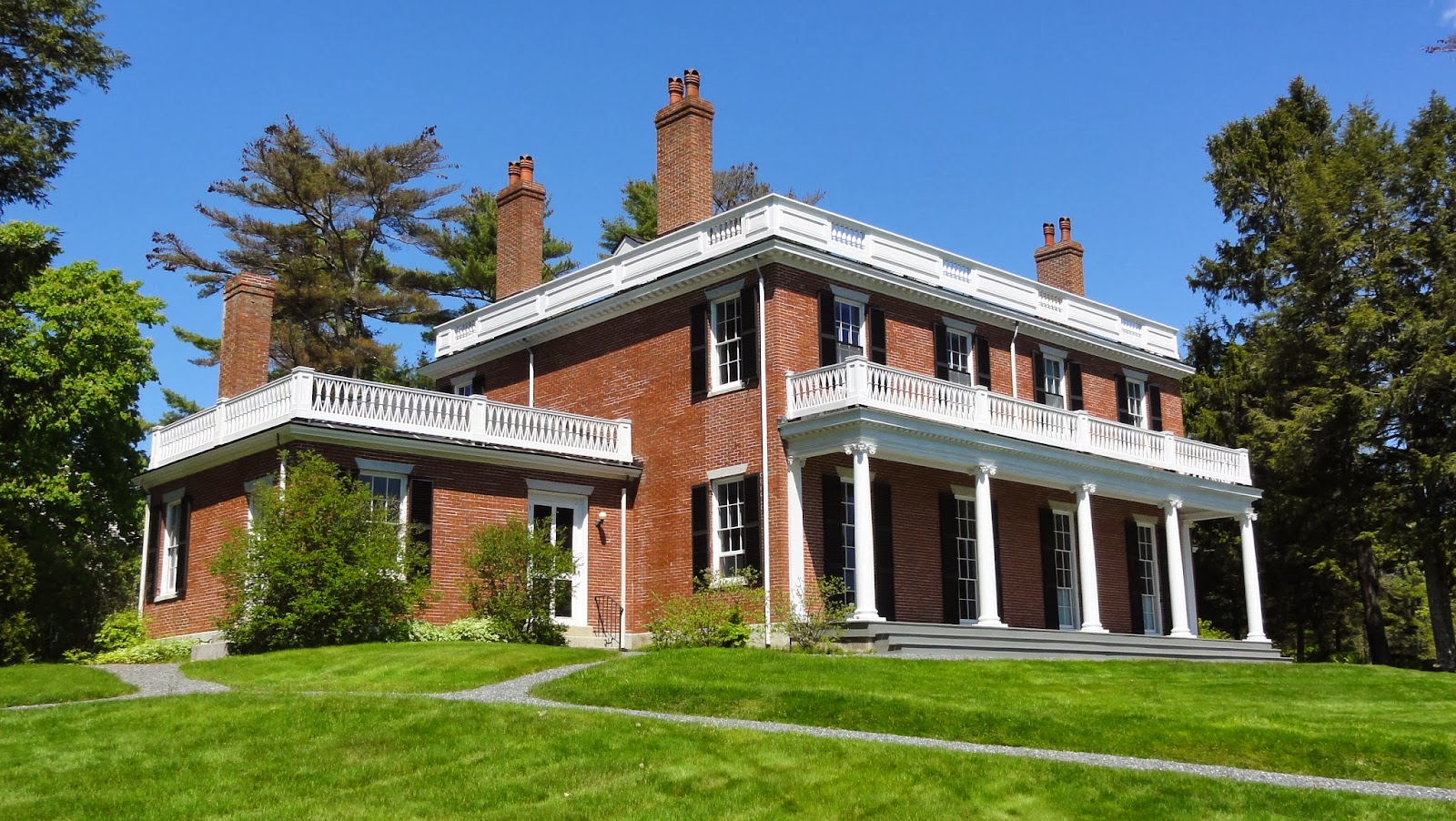
Black House was built between 1824 and 1827 in the Federal style with elements of the Greek Revival style. It's a handsome mansion of Philadelphia red brick containing furnishings and ephemera from as early as the 17th century.

Formal garden. Woodlawn - Black House, Ellsworth, ME

The formal garden behind the home is hedged with fragrant lilacs and furnished with sculpture. Simple arches allow entrance. Plantings include popular perennials such as daylilies (Hemerocallis), hostas, Bearded Iris (Iris germanica), Variegated Bishop's Weed (Aegopodium podagraria 'Variegatum'), Lamb's Ear (Stachys byzantina), Cheddar Pinks (Dianthus gratianopolitanus) and Lady's Mantle (Alchemilla mollis).

Fiddlehead ferns (Matteuccia struthiopteris), Bleeding Heart (Dicentra spectabilis), more hostas, and Solomon's Seal (Polygonatum biflorum) graced planting beds near the carriage house and sleigh barn. There is a cutting garden behind the sleigh barn. Our doggy companion was more interested in Woodlawn's dog house. By the way, you'll want to see Woodlawn's collection of carriages and sleighs.

The community garden is a newer development which provides plots for local gardeners who lack space enough to grow their own fruits and vegetables. I enjoyed a brief but delightful visit with local ladies tending their gardens. They were quick to advise me what hardware store I might visit to experience a bit of old-time Maine. My son commented they must not be real Mainers since they were so quick to share information.

It interested me that seaweed was a primary fertilizing mulch in the community garden. Not surprising, though, since Ellsworth is near the Maine coast.

More was in bloom beyond the gardens. Apple blossoms shed their petals upon the fresh, green grass. Bluets (Houstonia caerulea) and Sweet Violets (Viola odorata) sprouted in the lawn.

Bluets (Houstonia caerulea)
Woodlawn is home to one of Maine’s finest championship-sized croquet courts. Some gentlemen were sharpening their skills for the upcoming fifth annual Maine/New Hampshire State Croquet Tournament, held June 20-24.

Trails around Woodlawn allow visitors to round out their exercise with some hiking. Kiosks give directions. Farm artifacts provide interest and good excuses to pause occasionally.

As in much of New England, stone walls define Woodlawn's boundaries. There are about a mile and a half of them. They bear testimony to Woodlawn's origin as a gentleman's farm. Even gentlemen were sometimes exposed to the back-breaking labor of clearing land of rocks for planting.

Stone wall, Woodlawn - Black House, Ellsworth, ME
The grounds at Woodlawn are open from dawn to dusk year around with no admission charge. Admission is charged for house tours. Regular season for visiting the Black House runs from May to October. Christmas at Woodlawn runs from December 1 to 23.

Take your picnic basket when the weather warms. I suggest you go to Rooster Brother for fresh bread, cheese, and whatever else you might find to make a good picnic. After your picnic, stop by Mortons Moo for ice cream. (FYI, I have no connection to Rooster Brother or Mortons Moo, and gain nothing by recommending them. I like them very much. That's all.)

As I write this, Maine is covered up with snow. Take note of moose crossing signs. Moose may not be far off the road. If you visit Woodlawn in winter, take your snowshoes. You might find snowshoes and other winter apparel behind the big boot at L. L. Bean. (I don't have any relationship with L. L. Bean, either. I simply like their stuff.)

For more about Maine's history and the Black House, be sure to read Woodlawn - An Estate Of History.

Return to GoGardenNow.com.

Thursday, August 29, 2013

Thuya Garden and Asticou Terrace Trail, Northeast Harbor, ME

Thuya Garden vista from the Upper Pavilion
Charles K. Savage, a life-long resident of Northeast Harbor, ME and owner of the Asticou Inn was a lover of native plants and talented landscape designer. He was also a garden rescuer. When noted "landscape gardener" Beatrix Farrand decided in 1955 to quickly dispense with Reef Point, her family estate in Bar Harbor, for commercial development, Charles K. Savage stepped in to incorporate many of the plants in his own garden. Similarly, he transformed the orchard of Joseph Henry Curtis into Thuya Garden.

Curtis was a landscape architect from Boston who summered on Mt. Desert Island, ME for 48 years. His summer estate, Thuya Lodge, was situated high above Northeast Harbor, nestled among native white cedars (Thuja occidentalis). Thus the name, Thuya Lodge. Curtis established a trail from Asticou Terraces Landing to the lodge that allowed access to his lodge from the harbor, with terraces and shelters along the way.

From the landing's parking lot on Route 3, Peabody Drive, the trail climbs first to the Joseph H. Curtis Memorial terrace. A granite slab is carved with Curtis's profile in relief and acknowledges “The Asticou Terraces are his gift for the quiet recreation of the people of this town and their summer guests.” Native azaleas (Rhododendron canadense) flower against a granite backdrop.

Further along, a trail leads to Stone Lookout. The shelter provides a limited vista of the harbor and protection from rain. Most notable are its well-crafted rough-hewn beams and stone construction.

The trail might seem challenging to some visitors. Stone slabs seem to lead ever upward, sometimes past gurgling watercourses, sometimes to precipitous heights. But the trail is not difficult.

Panorama of Northeast Harbor

From the Second Lookout, a trail westward leads to the First Lookout. It's a smaller structure with rustic details providing an excellent panorama of Northeast Harbor. Like the others, it gives protection from the elements, though I suspect less on windy days.

To climb to Thuya Lodge, a visitor can walk to Old Grass Road and loop around to the Ascitou Hill Trail, or return to Second Lookout and proceed upward. Both are delightful paths to the lodge.

Joseph Curtis gave his estate in trust to the residents of Mt. Desert Island as a public park. Charles Savage was appointed trustee. It was Savage's vision to turn the lodge into a horticultural library and the orchard into a semi-formal, herbaceous garden in the manners of Gertrude Jekyll and Beatrix Farrand.

The heart of the garden is, of course, the expanse of lawn flanked by perennial borders. A plant list for 2013 can be downloaded from www.gardenpreserve.org. We missed the beautiful borders in full flower during our May visit. But volunteers were hard at work cultivating them.

Thuya Garden path
A path around the garden leads past a reflecting pool and Spring House. The Azalea Garden includes some rhododendrons salvaged from Ms. Farrand's nearby estate at Reef Point.

The Lower Pavilion and Upper Pavilion provide vistas of the herbaceous garden. As with the Asticou Terrace Trail lookouts, they are well-crafted with rough-hewn timbers. Both reflect something of the Japanese style that so fascinated Savage; especially so does the Upper Pavilion.

Savage completed the garden in 1962. Since then, it has been partially redesigned by Patrick Chasse, former garden curator at Boston's Isabella Stewart Gardner Museum, an authority on Beatrix Farrand. Chasse is a resident of Southwest Harbor, Maine.

Visitors to Thuya Garden can park in the Asticou Terraces Landing lot on Route 3, or drive to the lodge and park in the upper lot. The driveway entrance is also on Route 3. The sign marking it is easily overlooked.

Thuya Garden is open from May 1st through October 31st. Thuya Lodge can be visited from mid-June through mid-September.  The Thuya Garden and the Asticou Azalea Garden are owned and operated by the Mount Desert Land and Garden Preserve, a Maine non-profit corporation.

Return to GoGardenNow.com.

Friday, August 9, 2013

Asticou Azalea Garden, Northeast Harbor, ME

Asticou Azalea Garden vista across Asticou Pond

When noted "landscape gardener" Beatrix Farrand decided in 1955 to quickly dispense with Reef Point, her family estate in Bar Harbor, for commercial development, Charles K. Savage stepped in to incorporate many of the plants in his own garden. Savage was a life-long resident of Northeast Harbor, ME, correspondent with Farrand and owner of the Asticou Inn. Charles K. Savage was a lover of native plants and avid student of Japanese garden design. With the financial support of John D. Rockefeller Jr., he purchased the plants and added them to the Asticou Azalea Garden, which he designed and built in 1956. Follow me to see what grows behind that garden wall of Asticou Azalea Garden.

The entrance to Asticou Azalea Garden from Route 198 is not immediately obvious. However, the scene from Peabody Drive will turn your head, hinting there must be a way to get in there. Here's a map of Asticou Azalea Garden for you to find and explore it.

Asticou Azalea Garden is meant for strolling. It's a small garden, so you should have plenty of time to see all of it at a leisurely pace. Paths lead visitors through various garden rooms designed in Japanese style. The rooms, many incorporating water features, inspire a sense of serenity and balance. Vistas are designed to appear much greater than they actually are. Plant species include both native and non-native selections that are appropriate to the style and climate.

East meets West beautifully in the Asticou Azalea Garden. From winter with its hushed blanket, to spring and its exuberant floral display, to late summer's water lilies and fall's explosion of the year's last hot colors (see fall photos of Asticou Azalea Garden at Martha Stewart's blog), every season will delight you with its unique textures and colors. You'll return home with lots of ideas for your own garden. I hope you will enjoy these images of Asticou I captured during my visit in May.


For more about Beatrix Farrand, see:
Dumbarton Oaks

Learn more about the history of Northeast Harbor, ME and consider Northeast Harbor for your next vacation.

Return to GoGardenNow.com.