
Wednesday, July 23, 2025


Monday, January 3, 2022
Why is this called "Ice Plant"?
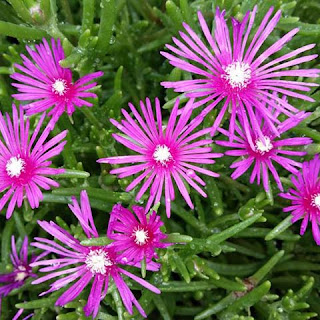 |
| Delosperma cooperi aka Ice Plant |
Q. Why is this called "Ice Plant"?
A. Delosperma cooperi is commonly known as Hardy Ice Plant. It's cold hardy into USDA Climate Zone 5. But its cold-hardiness is not the reason for the reference to ice. If you look closely at the slender foliage in the photograph above, you'll notice the glistening white surfaces. Upon examining with a magnifying lens, you'd see structures called epidermal bladder cells. These are what give Delosperma that ice-like glaze.
Incidentally, Hardy Ice Plant is also known as Mesembryanthemum cooperi. Mesembryanthemum is a genus that grows well in dry, salty, sandy environments. It thrives in South Africa, the Mediterranean region, parts of North and South America. Travelers along the Pacific Coast Highway 1 will see it often.
Ice Plant doesn't have to grow in sandy soil, but gardeners who have it, or who live in dry coastal areas will appreciate its abilities. It's an amazing little plant. To deal with heat, Ice Plant closes little pores (stomata) under its leaves to retain moisture. If it isn't getting enough salt, it takes up airborne saline through its foliage to retain moisture.
Mesembryanthemum leaves, flowers and seeds are edible. On top of that, the plant has medicinal qualities. It has been used to treat various ailments including liver, kidney and pneumonia. It is also used externally for skin treatment.
Hardy Ice Plant serves well as a ground cover in rock gardens, coastal and container gardens, succulent and cactus gardens, medicinal gardens, and xeriscapes. You should find a place for it in your garden.
Return to GoGardenNow.com.
Thursday, March 18, 2021
Choice Plants For The Coastal Landscape
A stroll on Hilton Head Island reveals a short list

Coastal landscapes are very demanding on plants. Strong sunlight, wind, sandy soil, and salt air require much. A recent stroll at Sea Pines, Hilton Head provided a short list of species that thrive in such conditions, at least in the Deep South.
Here’s what I found:
 |
| Nerium oleander flowers and leaves |
Usually known only as "oleander", its origins are unknown, though the Mediterranean region is likely. Nerium is usually grown in tropical and subtropical environments as a free-form shrub. It blooms all summer long. Flowers in colors ranging from white to red are fragrant. Variegated foliage is available. Maintenance requirements are extremely low.
 |
| Creeping Fig - Ficus pumila |
Creeping Fig is an elegant vine that does it's job gracefully, producing a luxuriant, evergreen covering where it is needed. Perhaps you have seen Creeping Fig covering garden walls in lovely cities of the Deep South. Clinging closely, it lends dark green softness to all kinds of structures.
 |
| Cycas revoluta - Sago Palm |
Cycas revoluta - aka Sago Palm - is not a palm at all, but a member of the ancient Cycadaceae family. It's native to Japan, and is comfortable in warm temperate and subtropical regions. Sago is popular throughout the South, in botanical gardens and landscapes.
 |
| Asparagus densiflorus 'Myersii' - Asparagus fern |
This member of the Asparagaceae family is not a fern, but an asparagus. It's hardy in USDA climate zones 9-11. While often used as a container plant, it also does well in the landscape, provided that it's protected during freezing weather. Though this particular plant was photographed in the sun, I've found that it has better color if grown in partial shade.
 |
| Salvia rosmarinus 'Prostratus' aka Rosemary |
As taxonomists would have it, Rosmarinus is now classified as a Salvia. But whatever. It's a fine plant for the coastal garden. Its Latin name is even derived from its native habitat meaning "dew of the sea." Rosemary is native to the Mediterranean region. Some varieties are susceptible to frost, but it thrives in heat and well-drained soil. Beside its ornamental use, rosemary is well-known for its culinary value.
 |
| Gelsemium sempervirens - Carolina Jessamine |
As I write this in mid-March, this gorgeous garland of yellow is in full bloom. Its range is from Virginia to Texas and southward through Mexico. Carolina Jessamine is one of my favorite flowering vines. It can be grown high or low, over your mailbox or under it. The deep yellow garlands in the trees drop lovely blossoms on the forest floor below, golden mantles drape garden walls, and the fragrance is wonderful.
 |
| Cyrtomium falcatum - Holly Fern |
This glossy, evergreen beauty is tough as nails. Its beauty is irresistible. Use if for ground cover, borders, accents. Gardeners in colder climates can grow it as a house plant.
 |
| Aspidistra elatior - Cast-Iron Plant |
 |
| Nephrolepis cordifolia - Erect Sword Fern |
 |
| Nandina domestica - Heavenly Bamboo |
 |
| Dianella tasmanica - Flax Lily |
 |
| Hedera algeriensis - Algerian ivy |
 |
| Asiatic Jasmine |
Asiatic Jasmine (Trachelospermum asiaticum) vines form a dense, glossy, evergreen mat, that suppresses weeds, making it an ideal ground cover. It thrives in full sun to full shade in USDA climate zones 7 to 9, and tolerates a wide variety of soil types. It's drought tolerant, deer and rabbit resistant. It's a ground cover that you're bound to love.


 Posts

