
Thursday, May 29, 2025


Friday, June 17, 2022
A Few Plants For Prepping Your Medicinal Herb Garden
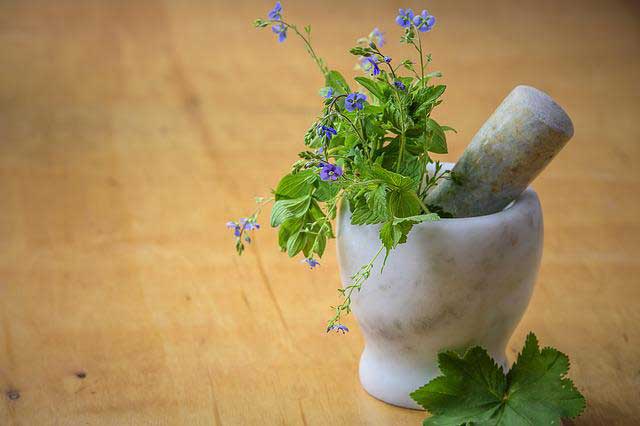
You’ve probably noticed that the prices of many commodities have gone up and their availability has diminished. The problems didn’t just begin with COVID lockdowns and the war in Ukraine. Those factors have contributed, but our economic problems have been building up for a long time. We’re now beginning to feel the result of many years of government and central bank mismanagement. As a result, people like us are thinking about how we can prepare for more inflation, recession and supply chain shortages.
Among the necessities of life are food, fuel and medicine. Thankfully, we can supplement them to some extent ourselves. Consider medicine, for example. Many commonly grown garden plants are beneficial for good health and treating what ails us. Can we do without our pharmacies? Absolutely not. Should we try to self-medicate without a doctor’s supervision? Again, the answer is “NO.” Some medicinal plants such as Gelsemium can be dangerous if taken without professional guidance. But it’s good to know that we can cultivate some of them in our own gardens, if only for the pleasures of growing them, satisfying our curiosity and for their ornamental value. Beauty is therapeutic. Is it not?
Consider the following few examples, and please follow the links to other interesting and useful information.
Achillea millefolium – Yarrow, Staunch-Weed – has been used since ancient times to stop bleeding, to sedate and treat anxiety, cure liver and urinary problems, improve digestion and reduce high blood pressure.
Ajuga reptans – Bugleweed is a traditional remedy to stop bleeding and bruising, mend broken bones, soothe throat irritation and mouth ulcers.
Aloe vera is well known for its healing properties for soothing superficial cuts, burns, insect bites and abrasions. I recently mentioned this to a medical professional who was sunburned. He was skeptical. “There are no studies proving Aloe’s efficacy in treating sunburns,” he said. “That’s an argument from silence,” I replied. I’ve applied it myself to burns to prevent blistering and scarring, and I know of many more who swear by it.
Basil is delicious and nutritious, as we all know. But it also contains antioxidants such as lutein and beta-carotene. These help to fight free radicals in the body. Free radicals can come from the foods we eat. Though they don’t last long, they can lead to cell damage and contribute to other conditions such as cancer, heart disease, arthritis, and diabetes.
Campsis radicans - Trumpet Creeper is useful for promoting perspiration and for treating wounds.
Dandelions are seldom welcome in our lawns and gardens, but they deserve to live. The botanical name, Taraxacum officinale, points to its traditional medicinal use as an anti-inflammatory herb. It has long been used as a purifying tonic, but it’s claimed to be effective in treating skin conditions, diabetes, liver and digestive disorders, among other ailments. Instead of eradicating it, plant it on purpose. It’s easy to grow. The leaves can be added to salads and dried for tea. The roots can be dried, ground, and used as a coffee substitute. Don’t expect it to taste like coffee, though.
.jpg)
Echinacea purpurea – Coneflower – is a lovely perennial that’s native to North America. It was long used by indigenous tribes to support the immune system. It also contains antioxidants for treating infections of the skin, fevers, and a host of related health issues. In addition to its medicinal value, it is very ornamental. It attracts birds and pollinators. Echinacea is an absolute MUST-HAVE for your medicinal garden.

one because it’s sometimes seen as an ingredient in homeopathic preparations, but it’s not to be prepared at home. Leave that to the Naturopaths. Naturalmedicinalherbs.net states,”The roots are analgesic, antispasmodic, diaphoretic, febrifuge, hypnotic, mydriatic, nervine, sedative and vasodilator. A powerful depressant of the central nervous system, deadening pain and reducing spasms. It is said to suspend and hold in check muscular irritability and nervous excitement with more force and power than any known remedy. Whilst it relaxes the muscles, it also relieves all sense of pain. It is used internally in the treatment of neuralgia, migraine, sciatica, toothache, severe pain (especially in terminal illnesses or accidents) and meningitis. Externally it has been used as a folk remedy for cancer. The root is best harvested in the autumn and dried carefully for later use. Extreme care is advised with the use of this plant, it should only be used under the supervision of a qualified practitioner. Excessive doses cause respiratory depression, giddiness, double vision and death. It should not be prescribed for patients with heart disease, hypotension or myasthenia gravis. See also the notes above on toxicity. The fresh root is used to make a homeopathic remedy. It is used in the treatment of a variety of complaints, including fevers, flu and headaches.” Enough said. Grow it as an ornamental or for sake of curiosity, but don’t try self-medicating. You might not even live to regret it.
.jpg)
Hemerocallis fulva – Common daylily. I wrote in another blog article about eating daylilies. They saying, “Let food by thy medicine” is attributed to Hippocrates. Well, here you go. Daylily is also used in medicine to increase urine flow, as a laxative, to reduce fever, stop vomiting, reduce muscle spasms, reduce pain and sedate. Daylily tubers are said to be antimicrobial and able to kill some internal parasites.
Heuchera micrantha – Alum Root, Coral Bells. The root is antiseptic, astringent, reduces inflammation and fever, and has been used to treat eye infections. A tea has been used to treat liver problems and sore throats. Chewing a piece of root, cleaned and peeled, soothes sore gums.
Hypericum spp – St. John’s Wort. Naturalmedicinalherbs.net states, “
-480x480%20(2021_06_17%2021_41_29%20UTC).jpg)
Whether other species are as beneficial, I don’t know.
Lamiastrum galeobdolon – Yellow Archangel suppresses muscle spasms, tightens tissues, promotes urine production, helps to discharge mucus, and expectorant, stops bleeding and tightens blood vessels.
Lavandula angustifolia – Lavender. Lavender is best known for its soothing aroma. But it is also a useful medicinal herb. It soothes the nerves, can be applied to the skin to help heal wounds, burns, and prevents scar tissue. It’s antiseptic, sweetens the breath, and improves kidney function. Rubbing lavender oil on the temples is said to cure headaches.
Liriope spp. – Liriope aka Lilyturf root has been used as an anti-inflammatory agent, an aphrodisiac, a treatment for allergies, and as a stimulant. Sometimes the roots have been candied and eaten as a snack.
Lysimachia nummularia – Creeping Jenny, Moneywort has been used to treat scurvy, diarrhea and internal bleeding. It increases urine production and is astringent.
.jpg)
Nepeta spp. – Catmint, Catnip. Everyone knows what it does to most cats, but it also has many medicinal uses. Tea from the leaves is useful for treating digestive disorders, reducing fevers, soothing colds and flu. It calms muscle spasms and coughs, relieves gas and increases perspiration.
Ophiopogon japonicus – Snakebeard, Mondo is a cough suppressant and expectorant, sedative, fever reducer and treatment for dry mouth. It has also been used as an aphrodisiac and cure for anxiety. (I guess if you think it works something amazing happens.)
Black-Eye Susan - Rudbeckia hirta has been used to treat earaches, sores, colds, and even dropsy.
Thymus spp. – Thyme. In addition to culinary uses, thyme can be used in deodorant. It is also antiseptic and disinfectant.
This is by no means an exhaustive review of medicinal plants, but should give you something as you begin prepping. The next thing to research will be about how to use them.
Return to GoGardenNow.com.
Saturday, March 12, 2022
Vine Recommendations For Privacy Fencing On Chain Link Fences
Do you have a chain link fence but would like to have greater
privacy? A vine might fill the bill. To grow on chain link, the vine
should have a twining habit. For reliable privacy, the it should be
evergreen. These are among the best choices, and they're all native. One caveat, though. Make sure you plant them only on your fence!
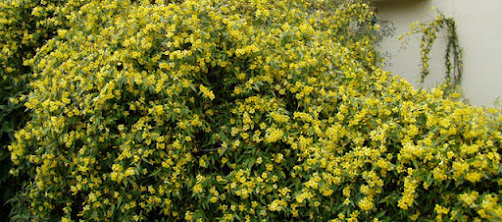
Carolina Jessamine – Gelsemium sempervirens. (Pictured above) It’s native from Virginia to Texas and southward. Because it’s evergreen, it provides a dense privacy screen year around. Carolina Jessamine is cold-hardy in USDA climate zones 7 through 9. It flowers best in full sun, but will grow in full sun or shade in well-drained soil with average to poor fertility. Recommended soil pH covers a wide range: from 5.5 to 8.5. Plants are drought tolerant when established, and deer resistant. Flowers are fragrant.
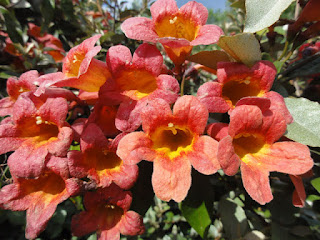
Crossvine – Bignonia capriolata. This one’s a vigorous vine that’s native to the southeastern United States. It climbs by tendrils which cling to anything for support. It thrives in many different soil types, but prefers rich, organic, well-drained soil. While it grows in sun or shade, more flowers are produced if grown in full sun. Crossvine is cold-hardy to USDA climate zone 6a.
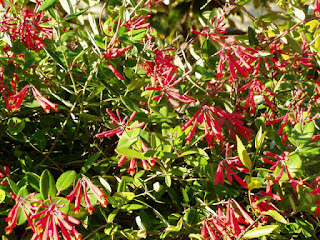
Trumpet Honeysuckle – Lonicera sempervirens. Here’s another vine that’s native to the eastern United States. Red, yellow or coral colored, trumpet-shaped flowers are produced intermittently on evergreen vines from spring to fall. It thrives in acidic soil in USDA climate zones 5 to 10.
All three of these vines flower prolifically, grow quickly, fill in densely, and require very little maintenance.
Return to GoGardenNow.com.
Thursday, October 24, 2019
Roadside Attractions


Gelsemium sempervirens
Carolina Jessamine
 Rudbeckia species

Black-Eye Susan

Campsis radicans
Trumpet Vine
 Coreopsis species

Hemerocallis fulva
Ditch Lily Ditch Lily is a species of daylily (Hemerocallis fulva) that is so common you’ll think it’s native, but it’s not. This naturalized beauty is spectacular en masse where you’ll often find it growing … you guessed it … in ditches. There is even a double-flowered ditch lily. Read more about daylilies. Ditch Lily is a species of daylily (Hemerocallis fulva) that is so common you’ll think it’s native, but it’s not. This naturalized beauty is spectacular en masse where you’ll often find it growing … you guessed it … in ditches. There is even a double-flowered ditch lily. Read more about daylilies.
With these roadside attractions popping up every so often, you’ll be tempted to stop and take a stroll, even if your car does have air-conditioning!
|
Wednesday, July 31, 2019
Here Are 5 Vines That Will Attract Birds To Your Garden

As I noted in a previous article, bird-watchers who want to see them up close usually attract them with bird feeders, houses and baths. There are, however, other ways of enticing them that shouldn't be overlooked. The landscape can be transformed into a bird sanctuary by including plants that provide food and shelter. Ornamental vines are important components of such a plan.
Here are 5 ornamental vines that birds find irresistible.
A Clarion Call For Hummingbirds
Trumpet Vine (pictured above) or Trumpet Creeper (Campsis radicans) is a climbing deciduous vine native to the southern United States. Travelers may have noticed it growing up and over fences and signposts along the highway. Large, bright yellow, orange to red trumpetshaped flowers appear from midsummer to fall. Campsis is popular world-wide for its stunning flowers, and because it attracts hummingbirds.
Yellow Garlands of Spring
Gelsemium sempervirens – known as Carolina Jasmine, Carolina Jessamine, Yellow Jasmine, and whatever else comes to the viewer’s mind – is another great native plant that provides nectar for the birds. It’s grown mostly for its glorious early spring flowers. Southerners wax nostalgic about it. Unfortunately, it is cold hardy only in USDA climate zones 7 through 9. The flowers usually appear before the hummingbirds arrive, so is best planted as a nectar source for other species. I’ve written much more about it in a blog article, Carolina Jessamine – The Yellow Garlands of Spring.Wild and Wonderful
 Most of us think of English ivy and all its varieties as a rampant but boring evergreen covering, or worse. But look closer and you’ll find a plant with lots of interesting variations that can not only provide mass ground- or wall covering, but also shelter and an ornamental food source for birds.
Some folks dislike ivy for it's vigorous growth habit. The very characteristic that makes it a fine ground cover can render it unwelcome; it covers ground. It's true that ivy can be troublesome if completely unchecked, but ivy does not damage trees or sound structures. It isn't a parasite. It cannot harm a mature tree, but it could outlive an old one. It cannot collapse a sound building. Ivy is a major food source for many birds, and the fruits ripen up just in time to fatten them before winter arrives. Hedera ivies also provide abundant shelter.
It Keeps Institutions From Crumbling
 Boston Ivy - Parthenocissus tricuspidata - is native to east Asia, not Massachusetts. Each leaf is composed of three lobes. In juvenile foliage, each lobe is very distinct. It is a vigorous climber, as anyone who has seen it on a wall knows well. Fall brings bright colors of yellow, orange, red or burgundy. The walls it adorns seem draped in a majestic tapestry. It is also widely used to cover trellises, pergolas, and as an ornamental ground cover for erosion control. Small flowers appear in July or August followed by fruits in October or November, and birds love 'em.
Boston ivy grows in any fertile, well-drained soil, and thrives in USDA climate zones 48. In other words, it'll probably perform well in your garden.
A Native With Great Possibilities

Virginia Creeper thrives USDA climate zones 3-9, a broader range than Boston ivy will tolerate. Its fruit and dense growth habit make it very attractive to birds for food and shelter.
These suggested vines, along with many bulbs, perennials, annuals, shrubs and trees will be welcome additions to your landscape from the birds' points of view.
Remember to think outside the bird feeder when you plan to feed the birds.
Monday, April 14, 2014
FAQ: Water run-off is causing an erosion issue. Should I plant Mondo?
 |
| Dwarf Mondo bare root divisions |
If you decide to install a blanket/mat, to help stabilize the soil until your ground cover plant matures, it should be made of organic material (like straw). I recently saw some for sale at our local farm supply store.
Faster growing ground covers include Campsis radicans (aka Trumpet Vine, a very aggressive native plant that will climb anything in its path), Euonymus fortunei (aka Wintercreeper), Gelsemium sempervirens (aka Carolina Jessamine, another native ground cover that will climb if given the opportunity), Hypericum calycinum (aka St. John's Wort), Juniperus conferta 'Blue Pacific' and Junipers horizontalis 'Wiltonii', Liriope spicata (aka Creeping Lily Turf), Pachysandra terminalis (aka Japanese Spurge), Trachelospermum asiaticum (aka Asiatic Jasmine), Vinca major (aka Big-Leaf Periwinkle) and Vinca minor (aka Periwinkle).
Bare root plants should be planted ASAP. If you can't get to them all at once, set the plants upright in the shipping box, keep them moist, avoid exposure to sun, wind and freezing temperatures.
Return to GoGardenNow.com.
Saturday, January 28, 2012
FAQ: Is Carolina Jessamine salt tolerant?

Q. We are interested in purchasing some Carolina Jessamine, but have a question. We plan to use it to climb on a pergola at our beachfront home. The local county agricultural extension agent says that it is salt-tolerant. What do you think? Do you know of anyone who has grown in successfully in a beachfront environment?
A. I can not think of a specific beachfront property where I've seen Gelsemium sempervirens growing, but that's probably because it is so ubiquitous in S. GA. I've seen it growing in the wild all over Skidaway Island. I was on Jekyll Island recently, and saw plenty of it near the rivers and beach.
A paper, SALT TOLERANT PLANTS Recommended for Pender County Landscapes published by Cooperative Extension Service, Pender County, NC, shows Gelsemium as being moderately salt tolerant.
I could not find a similar document from your state that names Gelsemium, but if it's salt-tolerant in NC it's salt-tolerant where you live.
Return to GoGardenNow.com.
Saturday, April 3, 2010
Peaches' Garden

Southern tradition, hospitality and comfort flourish in the home and garden of Roland and Peaches Barnes. One senses it even when passing by. Magnificent Deodar Cedars bathe the front lawn in cooling shade during the hottest days of summer, and the inviting glow from indoors spreads its welcome at evening. Near the street, a little plaque that Roland inherited designates this place as "Happy Forest." And it's about as good as it gets. Theirs is a life together of sowing, sewing, nourishing and enjoying the fruit of good work.
We have enjoyed their friendship for many years. Our children have grown up together. In fact, we all have grown up together, and can attest to their faithfulness and care.
Roland is the Senior Pastor of Trinity Presbyterian Church (PCA) in Statesboro, GA, which he planted in 1981. Peaches is an artist, specializing in "french hand-sewn" couture. Her work has been featured in well-known magazines including Veranda, Victoria, Sew Beautiful, Southern Accents, Southern Lady and Secrets of the South. Peaches is one-of-a-kind, as is each of her creations. She crafts each with her own hands, using only the finest materials, meticulous with the smallest details. Many of her masterpieces have already become treasured family heirlooms. You can learn more about her work at peachesbarnes.com.
Peaches is also a gardener, most interested in heirloom varieties traditional to the South. I visited recently. Accompanied by her grandson, she showed me about.

 Hers is a garden for children. The garden wall, softened with Magnolia grandiflora Little Gem, provides safety and places to hide. An antique playhouse invites her grandchildren, as it did her own children, to practice and play in a domain of their own. Raised-bed vegetable gardens are nearby to tend. After all that hard work, Peaches' salt-water pool beckons them for a swim. A classic pergola, accented with topiaries, provides a shady place to picnic or serve tea. Stone bunnies and squirrels nestle among ground covers and peek from behind shrubs.
Peaches collects plants that are deep-rooted in Southern tradition. Though not considered rare, they are more often neglected as gardeners desire newer selections. So, in her garden you'll find old-fashioned camellias and indica azaleas, spirea and irises, daylilies, hydrangea, ajuga, aucuba and nandina.

We could have visited longer, but baby Roeland crawled into his push car and begged to "go fast." So, off they ran for a quick lap or two around the yard.
Peaches' garden is not picture perfect. It's a living space. As we all know, happy forests are not always tidy, but they are comfortable and home to many.
Return to GoGardenNow.com.
Tuesday, July 21, 2009
Carolina Jessamine - The Yellow Garlands Of Spring
 Our native Carolina Jessamine, Gelsemium sempervirens, is a spectacular ornamental vine that is well-known throughout the South. Its range is from Virginia to Texas and southward through Mexico. Another species, Gelsemium rankinii, also known as Swamp Jessamine, is native to the Southeast. A relative, Gelsemium elegans, also a climbing vine, is native to India, parts of China and Southeast Asia. Gelsemium sempervirens translated from Latin means "evergreen jasmine". The common name, Jessamine, is a variant spelling of Jasmine. "Jasmine" is of Persian origin, meaning "God's gift." It must be noted, however, that Gelsemium species are not among what some consider to be "true jasmine" of the genus Jasminum.
Carolina Jessamine foliage (about 1" to 4" long) is elongated. Whether it is evergreen depends upon the climate. It is semi-evergreen in northern parts of its range. Beautiful fragrant yellow flowers, 1-1/2" long and tubular, appear in early spring and sometimes in fall creating elegant garlands of yellow on arbors and pergolas. Motorists are sure to notice it as they travel along our highways as Jessamine festoons trees and shrubs. Mature height as a ground cover is only 24", but when allowed to climb, it will just keep on going.
Carolina Jessamine is cold-hardy in USDA climate zones 7 through 9. It flowers best in full sun, but will grow in full sun or shade in well-drained soil with average to poor fertility. Recommended soil pH covers a wide range: from 5.5 to 8.5. If planted in shade, it will find something to climb until it enjoys sunlight. Plants are drought tolerant when established, and heat-loving.
Because the flowers are beautiful and abundant, Gelsemium is usually planted with that purpose in mind. Unlike some other ornamental vines, it does not attach itself permanently to its support. Gelsemium ascends by twining around the support. For that reason, if grown on a wall, it will need a trellis to climb upon. If necessary, it can be pruned back drastically in order to maintain supporting walls, trellises, pergolas, arbors, mail boxes and light posts.
Gelsemium can be effective as a ground cover for erosion control in small to large areas. If allowed to grow as a ground cover, it will certainly do so, but will climb the first chance it gets.
It must be noted that in spite of its loveliness, Carolina Jessamine is highly toxic if eaten. So don't. The good news is that it is deer-resistant.
Prepare the planting bed for Gelsemium sempervirens by cultivating at least 6" deep, removing all traces of weeds. Compacted soil should be cultivated to 12" deep. Add enough soil to raise the bed at least 4" above the surrounding ground level. This will help to promote good drainage. Composted manure may be incorporated into the soil. Fertilizer may be used. If you choose to do so, incorporate 5-10-15 fertilizer at a rate of no more 2 lbs. per 100 square feet into the top 4" to 6" of soil. Avoid synthetic fertilizers contacting any part of your plants.
Plant at 24" to 48" spacing. Dig planting holes into the cultivated soil a little less deep than the depth of the growing container. Place the plants into the holes and back-fill, watering as you go. Press soil around the roots. Do not cover the root balls with soil. The tops should be slightly exposed. Add a top-dressing of mulch around the plants, not on top of them, about 2" deep.
To encourage plant density and more profuse bloom, prune Gelsemium occasionally, especially if grown as a ground cover. Edging around the perimeter of the ground cover bed and shearing the top is very effective. Though Carolina Jessamine vines are capable of growing 20' high, they can be grown in containers on trellises of 3' to 4' and maintained by pruning.
Carolina Jessamine is one of my favorite flowering vines. It can be grown high or low, over your mailbox or under it. The deep yellow garlands in the trees drop lovely blossoms on the forest floor below, golden mantles drape garden walls, and the fragrance is wonderful.
Return to GoGardenNow.com.


 Posts
Posts

