Wednesday, September 16, 2015

How to move shrubs to a better place in your landscape.

Q. I want to move some shrubs to a better place in my landscape. Can you give me some helpful hints?

A. You didn’t say how large the shrubs are, or the kind. I’ll assume they’re small enough for a couple of people to manage with hand tools. I’ll give some general instructions regarding kind.

If you’re in no hurry to move them, I suggest you root-prune them to develop a more concentrated mass of roots near the base of the shrubs. To do that, you only need to take a nursery spade and slice downward into the soil in a circle around each shrub. By slicing through roots, you will encourage roots to branch within the circle. A three-foot diameter should be sufficient. After slicing, leave the plants in place for a few months. Be sure to fertilize and irrigate your shrubs within the circles.

It’s best to move them from late fall to early spring when they are dormant, or at least when not in an active growth stage.

For specific instructions on digging and transplanting, it is best to refer you to instructional videos. Since I haven’t created any on the topic myself, take a look at this one on How To Ball and Burlap Dig A Tree. Following that, view How To Plant A Ball and Burlap Dug Tree.

I hope this helps.

Return to GoGardenNow.com.

Wednesday, September 2, 2015

Sheep's Fescue - A Natural Beauty


Ah! Consider the pastoral life of sheep, wandering wherever they may and ruminating on the beauties of nature – mostly the grass.


Unfortunately, many people don’t think often about the beauty of grass except in lawns and golf courses. Gardeners are discovering, however, that hundreds of grass species stand out as ornamental beauties.


Sheep’s Fescue (Festuca ovina var. glauca) is one of them. It is native to many parts of Europe and Asia. I’ve but one inkling of why it was called Sheep’s Fescue; sheep seemed to like it.

The most common form is green. Leaf blades are stiff, wiry, and grow in dense, evergreen clumps six inches to twelve inches tall. The flowers are white, light and graceful. Sheep’s Fescue became most popular, however, when blue-bladed forms were discovered.

Sheep’s Fescue is popular with gardeners because:

  • It’s beautiful;
  • It thrives in USDA climate zones 4 through 10;
  • It grows in full sun or partial shade;
  • It’s drought-tolerant;
  • It grows in poor soil;
  • It requires very little maintenance.
Consequently, it is perfect for xeriscaping, massed planting as ground cover, low borders, accent planting, edging and container gardens. You can’t say all that about your typical lawn grass.

With lovely plantings of low-maintenance Sheep’s Fescue, you might find yourself ruminating more on the beauties of nature.

Return to GoGardenNow.com.


Monday, August 31, 2015

Gardens of Havre de Grace


Garden in Havre De Grace

Havre de Grace (pronounced: Have-ruh-duh-Grayce), Maryland is a small town you should visit. Located at the confluence of the Susquehanna River and the Chesapeake Bay, Havre de Grace has retained its historic charm though it has long been beside heavily-traveled routes along the Eastern Seaboard. It was formerly known as Harmer’s Town, named by the settler – Godfrey Harmer – who established it in 1658.  The Lower Susquehanna Ferry first crossed the river in 1695.

The Marquis De Lafayette visited several times while traveling up and down the coast to encourage American patriots and fight alongside them. It was he who suggested that the proposed city along the banks “should be called Havre de Grace” meaning “Harbor of Grace.” So it was.

Though small in size, Havre de Grace was proposed to be named the capitol of our new nation. It lost the distinction by one vote to the swamp along the Potomac.

Havre de Grace became a terminus of the Susquehanna and Tidewater Canal in 1839. The Underground Railroad route ushered slaves to new-found freedom in nearby Pennsylvania.

Nowadays, U.S. 40, I-95 and U.S 1 carry lots of traffic nearby. It’s amazing that so many people pass without knowing about the jewel of a town just down the hill.

As proudly noted on the Explore Havre de Grace web site, Smithsonian.com listed it among the Best Small Towns in 2014. Rightly so. Interesting shops and restaurants, museums, special events, walking tours and gardens satisfy tourists, and of course there’s the beauty of the Chesapeake Bay. Walkers can enjoy it from the Promenade. 

Havre de Grace Promenade


One particular feature of this part of the Chesapeake is the area known as the Susquehanna Flats. Millions of tons of sediment are deposited at the mouth of the river into the bay covering thousands of acres. Rich with submerged grasses, The Flats attract many species of wildlife, especially fish and waterfowl. Fishers and hunters follow.

Canada Geese


Havre de Grace is famous as the Decoy Capitol of the World. There’s no better place to learn about the history of hunting waterfowl and the decoys that attract them than the Havre de Grace Decoy Museum
Havre De Grace Decoy Museum

No matter your interest, a good walking tour can begin just about anywhere. Park your car where it’s legal and start strolling. That’s what I did. Follow me as we view landmarks and some of the gardens of Havre de Grace.

Concord Point Lighthouse
Concord Point Keeper's House

Concord Point Park
Raised beds in the making.

Peonies in bloom

Variegated boxwoods

Magnificent Fagus sylvatica purpurea
Gordonia alatamaha

Acer palmatum dissectum atropurpureum
Cornus kousa in bloom

History is best lived in.
Lovely clematis in bloom
Small, effective landscape planting
Hosta - America's favorite perennial.

Iris germanica
Quiet street scene


Old Bayou Hotel - Hot Spot of the Jazz Age


Rhododendron in bloom

Return to GoGardenNow.com.

Monday, August 24, 2015

My crape myrtles are covered with black on the leaves.

Sooty mildew on Eucalyptus
Bidgee [CC BY 3.0 (https://creativecommons.org/licenses/by/3.0)]

Q. My crape myrtles are covered with black on the leaves. It won’t wash or wipe off. What is it and how can I get rid of it? Will it kill my crape myrtles? 

A. The black stuff is called sooty mold or sooty mildew which includes several species of fungi that thrive in honeydew. Honeydew is a sticky secretion from the bodies of aphids, whiteflies, scale insects and similar pests.  Honeydew reminds me of tiny droplets of corn syrup spray. Wherever it falls – on other plants or even your walkway – sooty mold will appear.


It’s futile to try removing the existing mold on leaves, but you can prevent it from appearing on new ones. Get rid of the insects. You’ll get rid of the mold. Shop your local garden center for insecticides labeled for the target insects. If mold occurs on ornamental plants, I prefer products containing systemic insecticide/fertilizer combinations. If applications are begun early in the season, you may prevent insect and sooty mold infestations all summer long.


Sooty mold will not kill your crape myrtles. However, the black film does interfere with exposure to sunlight, which is essential to photosynthesis. Repeated infestations can weaken your plants.

Return to GoGardenNow.com.

Tuesday, July 14, 2015

My creeping phlox died. What, if anything, can be done?

Creeping Phlox (Phlox subulata)

Q. I planted creeping phlox in May. I lost some within the first few weeks. I figured I would loose a couple, however every one of them died. I'm not sure why they died, the flower bed has a sprinkler system and it waters early morning and late evening. I thought phlox was a hearty plant. What, if anything can be done? Thank you!

A. I'm sorry to hear that your creeping phlox didn't survive. You said that they were watered twice per day. I'm sure your phlox drowned.

The soil condition for Phlox subulata should be well-drained to dry. The sun exposure should be "full sun." You didn't say whether they were planted in full sun. Should you think about planting phlox again, make sure they get full sun. You'll also need to reduce the irrigation significantly. Otherwise, I recommend you consider ground covers that will tolerate moist soil and partial shade.

Lysimachia, for example, thrives in full sun to partial shade in USDA climate zones 3 through 10 in moist soil. Because it needs consistent moisture, partial shade is recommended in the hottest climates, though heat itself is not the issue. Recommended soil pH ranges from 5.6 to 7.5.

Acorus gramineus thrives in moist to wet soil in partial shade to full shade.

Carex grows in wet to very moist soils but prefers evenly moist, well drained, loamy, sandy or clay soils. It may tolerate shallow standing water for awhile, but never dry soil. Depending on the species, they like partial to full shade. Some tolerate full sun.

Mazus reptans produces blue or white flowers. It is cold hardy in USDA climate zones 4 to 9, thriving in consistently moist soil in full sun to partial shade. Some protection from the sun is appreciated in very hot climates. Recommended soil pH is 6.1 to 8.5. Plants spread rapidly, rooting as they go. Small, plug-like portions can be dug and re-planted elsewhere.

These are but a few suggestions. I hope this helps.

Return to GoGardenNow.com.

Tuesday, July 7, 2015

Must-Have Plants: Blue Pacific Juniper

Juniperus conferta 'Blue Pacific'

Must-have plants are among the best plants for appropriate garden situations. When you need great garden plants for ground cover, naturalizing, wildflower gardens, perennial borders, butterfly gardens, hummingbird gardens, herb gardens, heritage gardens, cutting gardens, woodland gardens, shade gardens, bulb gardens, container gardens, bog gardens, water gardens, rain gardens or xeriscaping, look for the best among our must-have plants.

Juniperus conferta 'Blue Pacific', also known as Blue Pacific Juniper, is a big improvement over the well-known Shore Juniper because the height is shorter and foliage color is better.

Name(s): Juniperus conferta 'Blue Pacific', Shore Juniper.

Flower Color: Not applicable.

Bloom Time: Not applicable.

Foliage: Evergreen, blue-green, needle-like.

Height/Spread: 6 inches to 18 inches x 36 inches to 48 inches.

Climate Zones: 4, 5, 6, 7, 8, 9.

Sun Exposure: Full sun.

Soil Condition: Well-drained to dry, average to poor, pH 5.1 to 7.8.

Features: Drought tolerant, deer resistant, salt-tolerant.

Uses: Xeriscaping, massed planting, ground cover, erosion control, coastal gardens.

Comments: The foliage of Juniperus conferta 'Blue Pacific' is needle-like. Mature height is 6 inches to 18 inches. 'Blue Pacific' spreads to 48 inches.

'Blue Pacific' prefers full sun in USDA climate zones 4 to 9. Average well-drained garden soil is fine. It adapts to a wide variety of soil types and pH levels, and is salt-tolerant.

Juniperus conferta 'Blue Pacific is an excellent ground cover solution for medium to large areas. It performs well in coastal gardens, and dry, sandy soils. 'Blue Pacific' is superb for erosion control.

Return to Juniperus at GoGardenNow.com.

Monday, July 6, 2015

Leucojum - White Violets of Spring and Summer

Leucojum aestivum in Peaches Garden

Leucojum species, members of the Amaryllidacea family, are native to Europe, the Middle East, the Caucasus region, but you will find them naturalized almost everywhere. L. vernum is hardy in USDA zones 3 to 9. It blooms late winter to early spring. L. aestivum is hardy in climate zones 4 to 9. It blooms late spring to early summer. Of the two, L. vernum is shorter, growing 6 inches to 12 inches height. L. aestivum grows from 12 inches to 18 inches.

Leucojum comes from Greek words "leukos" and "ion" meaning "white" and "violet." The Latin word "aestivum" translates "summer."  "Vernum" means "spring."

"But," you might say, "they're not violets." True, if you're thinking of Viola species or African violets. But, African violets aren't Violas, either.

By now you've learned I like to study names (onomatology), wondering why things are dubbed so.

Apparently, Leucojum was named "white violet" because there was a time when "violet" was applied to many adorable plants and daughters. Peter Lauremberg (26 August 1585–13 May 1639) aka Petru Laurembergius, in Apparatus plantarius: de plantis bulbosis et de plantis tuberosis, opined, "Vox Violæ distinctissimis floribus communis est. Videntur mihi antiqui suaveolentes quosque flores generatim Violas appellasse, cujuscunque etiam forent generis quasi vi oleant."

Not knowing much Latin, I went to Google Translate which rendered: "The voice Violets distinctissimis flowers is common. It seems to me the old sweet-scented flowers men generally Violas appealed, irrespective of the kind that would force oil." There you have it. However, not even that clarification ended my wonderment.

There's also the issue of common names. L. aestivum goes by Summer Snowflake, Dewdrop and Snowdrop. L. vernum is called Spring Snowflake and St. Agnes Flower. Why these?

Galanthus species are also called Snowdrops. Leucojum and Galanthus (meaning "milk flower") bloom near the same time and they do look somewhat similar, therefore that may explain the shared names.

So, when Wordsworth wrote,

"LONE Flower, hemmed in with snows and white as they
          But hardier far, once more I see thee bend
          Thy forehead, as if fearful to offend,
          Like an unbidden guest. Though day by day,
          Storms, sallying from the mountain-tops, waylay
          The rising sun, and on the plains descend;
          Yet art thou welcome, welcome as a friend
          Whose zeal outruns his promise! Blue-eyed May
          Shall soon behold this border thickly set
          With bright jonquils, their odours lavishing               
          On the soft west-wind and his frolic peers;
          Nor will I then thy modest grace forget,
          Chaste Snowdrop, venturous harbinger of Spring,
          And pensive monitor of fleeting years
!" - To A Snowdrop,

there's no telling which he was musing about.


Why St. Agnes Flower? Probably in memory of Agnes of Rome (c. 291 – c. 304), a virgin–martyr, patron saint of chastity, virgins (traditionally females, but not necessarily so), holy innocents of both sexes, gardeners (who are always pure in heart), engaged couples (men and women who should be chaste until their weddings), and rape survivors.

Tiffany, in her Family At The Foot Of The Cross blog, wrote, "Some people refer to snowflakes as St. Agnes flowers because she holds a winter feast day." Snowflakes are usually considered to be pure, until they touch the ground. Leucojum seldom bloom as early as the Feast of St. Agnes (21 January), but if you look into an open Leucojum flower and use a little imagination, you'll see the shape of a snowflake.

Voilà! or maybe Violà!

Plant Leucojum bulbs in full sun to partial shade, in slightly moist to well-drained garden soil with pH ranging from 6.1 to 7.8. Planting hole should be 4 inches deep or 2-1/2 times the height of the bulb. Space the bulbs 4 inches apart.

Leucojum species are good for cutting, bulb gardens, perennial borders, container gardens, rock gardens, naturalizing, theme gardens, shade and woodland gardens.

Return to GoGardenNow.com.

Tuesday, June 30, 2015

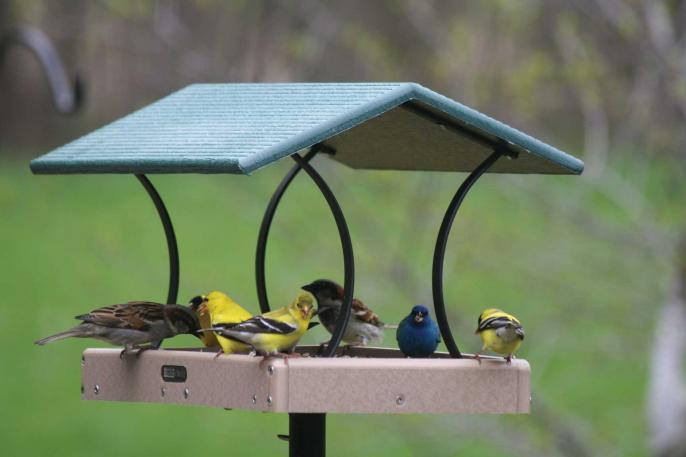
How can I attract more birds to my yard?

Birds Choice SNFT-200 Recycled Fly-Thru Feeder

Q. How can I attract more birds to my yard? Can you recommend the best bird feeder for that purpose?

A. Since all birds don't eat the same food, I recommend a feeder that presents a diverse menu or several feeders containing different offerings. Bluebirds, for example, primarily eat insects, larvae and small berries. They also may eat suet with peanut butter. Woodpeckers are attracted to suet, fruit, insects. Finches love niger seed. Cardinals go crazy for sunflower seed.

You shouldn't rely on bird feeders alone to attract more feathered friends. You'll do well to improve the habitat around your property.

There are four things good habitat requires:
  • Food
  • Water
  • Shelter
  • Cover
Bird feeders, of course, provide food, but you should also consider landscaping with plants that do so.  Ilex, crabapples, Eastern red cedar, Vaccinium and Viburnum are good fruit sources. Vines such as Campsis provide nectar. Perennials such as Achillea, Asclepius, Coreopsis, Echinacea, Mondarda, Rudbeckia, and Salvia provide seed or nectar.

Bird baths help provide water, but so do rain gardens and shallow ponds. Drippers and misters also attract various species.

Bird houses provide shelter, but so do dense trees and shrubs. Many of the food plants provide shelter. Also consider providing yarn, left-over cotton and linen cloth for nesting material. I've seen birds make off with wads of dog hair left in the yard.

Cover has more to do with providing safe places from predators. Bird houses don't always do it, as anyone who has found a snake in her bluebird house can attest. Again, dense shrubs and trees that are somewhat out of reach provide roosting places. Thorny plants such as roses and blackberry thickets act as deterrents from predation.

So, you can see there are many ways to attract more birds. As a bonus, you will find other wildlife species will also be attracted to the habitat you create.

Return to GoGardenNow.com.

Wednesday, June 10, 2015

Hopelands Gardens - A Remnant Of The Gilded Age


Camellia japonica at Hopelands, Aiken, SC

Scattered throughout the South are historic winter retreats of the Gilded Age where wealthy northerners have come to exploit, rest and play. Drawn by some salubrious attractions, the rich and famous have established enclaves for their pleasure and left their mark. One such is in the city of Aiken, South Carolina.

Aiken was incorporated in 1835 at the Savannah River terminus of the South Carolina Canal and Railroad Company's line, and named for the company's first president, William Aiken (1779 - 1831). As a seasonal resort for millionaires, it became home to the Aiken Winter Colony in the late 19th century. Among its well-heeled families were Vanderbilts, Harrimans, Astors, Pinkertons, Graces, Hitchcocks, Whitneys, Bostwicks, Eustis, Goddards and Iselins. The community was so popular that a direct rail line was established from New York to Aiken.

Life was tough for everyone during the Great Depression and World War II, but not so difficult for the Winter Colony residents that they couldn't establish two horse racing centers. The Aiken Mile Track was built about 1935 or '36 for training and racing trotters. Subsequent infield tracks were added for hurdle racing and steeplechasing. The Aiken Training Track was established in 1941 around what is probably the country's oldest polo field. No doubt the tracks contributed to Aiken's continued prosperity. Aiken continues to be a training ground for "the sport of kings."

The Winter Colony attracted the attention of William Goddard (1825 - 1907), a decorated Yankee Civil War hero from Rhode Island. After graduating from Brown University, he traveled internationally gaining experience in manufacturing and mercantile businesses, and carrying secret dispatches to American allies oversea. He and his brother Thomas established Goddard Brothers working as agents for textile mills owned by their uncles. Goddard Brothers grew to be an important management firm. William went on to become the president of Providence National Bank, and Chancellor of Brown University.

Goddard gained a reputation for his yachting prowess. He was a founding member of the Narragansett Yacht Club.

William Goddard bought property in the Aiken Winter Colony and named it Hopelands, like his other large estate in Warwick. Hopelands in the South was in a fine neighborhood. He was all about hope.

Rye Patch, the winter home of Edmund Pendleton Rogers (1882 - 1966) and his wife, Dorothy Virginia Knox Goodyear Rogers (1896? - 1980) was right next door. Even their names strongly hint of American enterprise and shoulder-rubbing with nobility. The Goddards often stayed with the Rogers when wintering in South Carolina. Goddard saw how much his daughter Edith Hope (1868 - 1970) enjoyed their stays, so he gave his property there to her upon her marriage to Charles Oliver Iselin (1854 – 1932). The New York Times effused “Hope Goddard Engaged to C.O. Iselin, Well-Known Yachtsman to Marry Heiress of  Millions.”

Charles Iselin was a banker and a member of a wealthy family. He grew up sailing near Long Island, New York in difficult little boats prone to capsize. With that experience, he excelled to become "one of the greatest American Yachtsmen of his time, participating in and winning six consecutive America’s Cup races." No doubt, his love of sailing and more drew the attention of William Goddard, and his daughter's.

Charles and Hope married and made their home at the Iselin New Rochelle estate - All View - where he docked his yachts "Defender’’, ‘’Reliance’’ and ‘’Columbia’’. Hope became the first woman to serve as a crew-member of an America's Cup yacht.

Hope outlived her husband.

Edith Hope Iselin
Sailing with Charles was not Hope's only sporting interest. She was also an avid equestrian and loved the "sport of kings." She supported horse racing in Aiken.

The home in South Carolina must have seemed like a cabin in the woods compared to her magnificent mansions up north, but she loved it. Hope took care to landscape properly with the influence of Frederick Law Olmstead, the architect who designed Central Park, Druid Hills in Atlanta, and other great American landscapes. Olmstead was the Iselin's personal landscape architect. She probably enjoyed watching guests from her porch enjoying her gardens. She could stroll easily to the her stables and equestrian venues.

If you visit, you'll see the old house no longer exists. It was razed according to the terms of her bequeathing the property to the City of Aiken. I asked a docent why. He had no idea, but opined that the home needed extensive repairs. Perhaps she wanted to spare the city the expense of fixing it. Her gardens remain.

With history in mind, you should visit Hopelands Gardens. The appreciation of a place makes it stand out in one's experience.

Aiken Thoroughbred Racing Hall of Fame and Museum

Right after after walking into Hopelands, you'll see the Aiken Thoroughbred Racing Hall of Fame and Museum, "Home of Aiken's Racing Champions." Keep in mind it's not a memorial to all the great race horses of the world, but if you want to delve deep into the history of horse racing in Aiken, South Carolina this is your place. Housed in a former stable, it is truly amazing. Once you're drawn in, you will be ready to mount a horse, start looking for a bookie, or buy a souvenir.

Live Oak (Quercus virginiana). Hopelands, Aiken, SC


Hopelands is gracious. Wide paths curve beneath century-old live oaks and among impressive specimen shrubs such as camellias, hollys and tea olives. In summer, concerts are performed on a stage near one of the ponds.

Performing Arts Center. Hopelands, Aiken, SC

Strolling through the garden, one can't help but muse about what life must have been like here during the Gilded Age. Hope Goddard would be pleased to know that her gardens are still enjoyed by all who visit.
Pyracantha. Hopelands, Aiken, SC


Pansies in terra cotta. Hopelands, Aiken, SC

Espalier arch. Hopelands, Aiken, SC


Hopelands, Aiken, SC
Greyhound sculpture. Hopelands, Aiken, SC
Pond and amphitheater. Hopelands, Aiken, SC

Return to GoGardenNow.com.