
Sunday, July 21, 2024


Thursday, June 3, 2021
Ferns As Groundcovers

Winding through palmy fern, and rushes fenny,
And ivy banks; all leading pleasantly
To a wide lawn, whence one could only see
Stems thronging all around between the swell
Of turf and slanting branches: who could tell
The freshness of the space of heaven above,
Edg'd round with dark tree tops?...
Southern Sword Fern
 |
| Nephrolepis cordifolia |
Nephrolepis cordifolia - aka Southern Sword Fern - is among the most widely used ferns in southeastern U.S. landscapes. They're tough as nails and very easy to grow. This evergreen species presents upright sword-shaped fronds with closely spaced leaflets. They spread by runners, and tolerate drier, poorer soil than most ferns, especially in shaded areas. They'll also thrive in full sun with sufficient irrigation.
Hay-scented Fern
 |
| Dennstaedtia punctilobula |
Christmas Fern
 |
| Polystichum acrosticoides |
This evergreen beauty is one of our most useful native ferns. Polystichum acrosticoides really stands out in winter. Also known as Christmas fern, the glossy foliage has been gathered since colonial times for Christmas greenery. I never fail to point out to my grandchildren that the leaflets are shaped like elves' shoes.
Autumn Fern

Southern Shield Fern
 |
| Dryopteris ludoviciana |
So, what if you need a fern for a sunny location? Look no further than Southern Shield fern or Southern Wood fern - aka Dryopteris ludoviciana. This gorgeous North American native is found from Kentucky to Florida, and westward to Texas. That's USDA climate zones 6 - 10. Foliage is evergreen, too. It's a big one, growing up to 48" in height! Average, slightly moist soil with pH ranging from 6.1 to 7.5 will be ideal.
Wednesday, June 2, 2021
FAQ: On Planting Hay-scented Ferns - Dennstaedtia puntilobula
 |
| Hay-scented ferns |
Q. The video shows green fronds however the picture that accompanies the web page does not. How can I tell which is "up" if there are no fronds emerging? Thanks!
A. The rhizomes are laid horizontally into a shallow trench. There may be some new shoots emerging from the rhizomes when you receive them, which will help you determine which side is up. Even if you get it "wrong", they'll come out alright. But the correct side should be self-evident.
 |
| Hay-scented fern rhizome |
A. High quality potting soil should not have weed seeds in it, so the only weed seeds would be in your native soil surrounding the area. If you decide to use compost, I suggest you mix it with native soil, but that presents the potential weed problem. If you cover the rhizomes too deeply with soil/compost/bark, they might have difficulty emerging, if at all. So, care must be taken for that reason. Depending on your situation, you will probably have to pull some weeds either way, but probably fewer if you use a very high quality potting soil to cover the rhizomes.
Return to GoGardenNow.com.
Sunday, May 16, 2021
Charming Plants for Wedding Favors and Table Decorations

 |
| Candytuft |
 |
| Coreopsis |
Coreopsis promises wealth and cheerfulness.
Chrysanthemum/Dendranthema assure friendship, love, and all the best wishes.
 |
| Dianthus |
Dianthus tells of love, affection, gratitude, admiration, and hints of a little bit of whimsy thrown in for good measure.
 |
| Japanese Painted Fern |
Goldenstar bets on good luck and healthy ambition.
 |
| Ivy |
Ivy (Hedera) declares eternal fidelity.
Moneywort hopes for wealth and life-long happiness.
 |
| Creeping Phlox |
Rudbeckia is full of bright encouragement.
St. John’s Wort declares God’s design for marriage and home.
 |
| Thyme |
Verbena signifies romance, pleasant memories, happiness, personal creativity, and protection.
 |
| Veronica |
Veronica/Speedwell hopes for healing, recovery from broken hearts, and joyfulness.
Vinca expresses nostalgia, benevolence, and purity of heart.
 |
| Yarrow |
 |
| Yellow Archangel |
Saturday, May 15, 2021
Springtime, Loving, And The Meaning Of Flowers
Now is the month of maying,
When merry lads are playing,
Fa la la la la la la la la,
Fa la la la la la la lah.
Each with his bonny lass
Upon the greeny grass.
Fa la la la la la la la la, etc...
The Spring, clad all in gladness,
Doth laugh at Winter's sadness,
Fa la la, etc...
And to the bagpipe's sound
The nymphs tread out their ground.
Fa la la, etc...
Fie then! why sit we musing,
Youth's sweet delight refusing?
Fa la la, etc...
Say, dainty nymphs, and speak,
Shall we play barley break?
Fa la la etc…
[She] and [he] sitting in a tree,
K-I-S-S-I-N G.
First comes love,
Then comes marriage,
Then comes baby in a baby carriage.
It’s the natural progression of things.
Gifts are often plucked straight from the garden – or purchased – to express deepest feelings, and, traditionally, those gifts have had special meanings. In fact, an entire language of flowers developed over the centuries. It’s called floriography. With the language of flowers, friends and lovers have been able to express themselves without words, which, for sake of modesty or or other reasons, are sometimes better left unsaid.
The language of flowers is also helpful for expressing sympathy, disappointment, timidity – the whole range of human emotions.
Whether intended for deepest heartfelt expressions, occasional gifts or wedding favors, here are a few to consider.
Astilbe – Dedication and patience.
Yarrow (Achillea) – Love, healing a broken heart, courage and inspiration.
Ivy (Hedera) – Eternal fidelity, strong attachment.
Ferns – Luck, riches, happiness, family bonds, hope for future generations.
Candytuft (Iberis) – Joy, sweetness, and beauty in the face of adversity.
Coreopsis – Wealth and cheerfulness.
Daylily – Depending on the color, they can symbolize purity, innocence (white); devotion, motherly love, joy, beauty and courage (orange and yellow).
Chrysanthemum/Dendranthema – Friendship, love, well-wishing, death and grief (white).
Carnation – Depending on the color, they can symbolize purity, innocence, death (white); life and love (red); gratitude (pink); rejection (yellow).
Dianthus – Love, affection, gratitude, admiration, whimsy.
Goldenstar – Good luck, ambition.
Plumbago – Hope and well-wishing.
Iris – Trust, courage, hope.
Yellow Archangel – Wisdom, courage, protection.
Lily-of-the-Valley – Good luck in marriage, happiness, love.
Liriope – Nymph-like, capriciousness.
CreepingJenny/Moneywort – Wealth, happiness,
Catmint – Love, fertility, happiness.
Phlox – Harmony, unity.
Rudbeckia – Encouragement.
St. John’s Wort – God’s design.
Thyme – Healing, young love, romance, courage.
Verbena – Romance, pleasant memories, happiness, creativity, protection.
Veronica/Speedwell – Healing, recovery, joyfulness.
Vinca – Nostalgia, benevolence, purity.
With so many flowers to choose from, you can express all your loving thoughts without speaking a word.
Return to GoGardenNow.com.
Tuesday, January 22, 2019
Behind A Garden Wall: Edith J Carrier Arboretum at James Madison University
 |
| Edith J Carrier Arboretum entrance |
I recently visited for the first time. Follow me to see what grows behind the garden wall.
Upon entering, a trail to the right leads to a labyrinth on a hill. I gave it a miss.
The best place to begin your visit will be at the Frances Plecker Education Building. Maps, a library, exhibits are available. A fair portion of the arboretum is in view of the terrace.
 |
| View from the terrace |
Exhibits along the way include:
 |
| Monarch dinner menu |
- Viette Perennial Garden - donated by André Viette, noted horticulturist, featuring daylilies (Hemerocallis), irises (Iris) and peonies (Paeonia) in seasonal bloom;
- Drury Planting - Includes weeping bald cypress (Taxodium distichum 'Cascade Falls'), bigleaf magnolia (Magnolia macrophylla), Japanese maple (Acer palmatum 'Bloodgood', redbud (Cercis canadensis 'Forest Pansy'), dogwood (Cornus florida 'Cherokee Sunset'), and spirea (Spiraea x bumalda 'Dolchica', flowering from April to June;
- Smith Shale Barren - "Perhaps the most unique of the arboretum’s gardens, this man-made shale barren is the only one of its kind in a public garden in Virginia and displays over a dozen strict endemic perennials that make their home in extreme conditions: harsh, direct and prolonged sunlight and high temperatures, in flower March to July";
- Wetlands Garden - featuring aquatic and bog plants typical to that environment;
- Hall Garden - featuring a large green ash tree (Fraxinus pennsylvanica), bluebells (Hyacinthoides spp.), Jack-in-the-pulpits (Arisaema triphyllum), ferns (Pteridophytes) and foamflowers (Tiarella cordifolia), yellow magnolia (Magnolia x 'Butterflies') and various native shrubs;
- Monarch Waystation - "A pollinator garden providing habitat for a variety of insects, including butterflies like Monarchs, that require host plants for caterpillars and nectar plants that support the nutrient needs for their migration", including a handy menu for the hungry pilgrims to make their selections.
- Fern Valley (which needs no explanation);
- Dale Hybrid Azalea Experimental Planting - best viewed from April to July;
- MacDonald Azalea and Rhododendron Garden - best viewed from March to July;
- Mid-Atlantic Chapter of the American Rhododendron Society Native Azalea Garden - also best viewed from March to July;
- Wood Wildflower Garden - flowering April and May;
- Bodkin Oak-Hickory Forest;
- Herb Garden;
- Sycamore Flat - a wildflower meadow and swale with stream and native plants.
 |
| Swinging bridge over the stream |
 |
| Fun things to do in the Children's Garden |
 |
| Sculpture (Some are for sale!) |
 |
| Meandering stream |
 |
| Woodland walk |
 |
| Sculptures |
 |
| Making good use of a rotting tree trunk |
 |
| Sculptured benches |
 |
| Educational station to explore tree roots |
 |
| Entrance to Children's Garden |
 |
| Whimisical sculpture from tree roots |
 |
| Red twig dogwood |
 |
| Carrier Arboretum banner |
 |
| Edith J Carrier Arboretum entrance |
 |
| Arum italicum |
 |
| Fragrant Edgeworthia chrysantha |

Monday, August 6, 2018
Fascinating Fern Facts
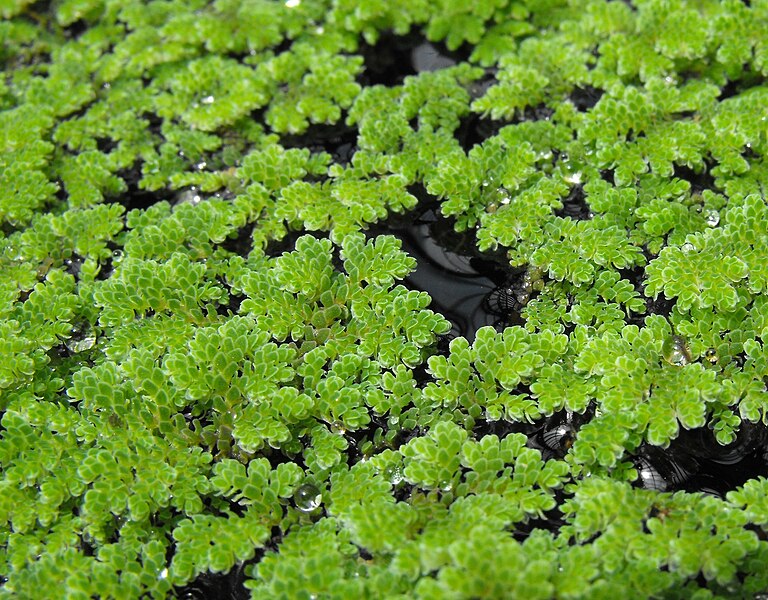 |
| Azolla filiculoides. Image: Public domain |
This just in from Quartz.
Fifty million years ago, a tiny fern called Azolla filiculoides grew in mats over open water in the Arctic Ocean, flourishing like that for 800,000 years. (It now turns up in Arctic ice cores in vast quantities.)
This was a significant event not just for fern domination but for the globe: Paleobotanists call it the “Azolla event,” because the Azolla mats sucked up 10 trillion tons of carbon dioxide during that period—well over 200 times the total amount of carbon dioxide humans currently release into the atmosphere every year. The event played a role in the abrupt shift from a very warm planet to the cool one we now inhabit.
Soooo...
Scientists have wondered for years if Azolla could be harnessed to cool the planet again.
Sure. Why not? I'm all for it if the research is privately funded.
This and other fascinating fern facts are for learning in today's email from Quartz. It's a great resource for thought-provoking info on a lot of topics. Check it out. I believe you'll enjoy it.
It occurs to me, though, that according to the USDA, Azolla filiculoides - aka Mosquito fern - is already native to Florida, the Pacific coastal states, and even New York. (I'm assuming we're referencing the same Azolla filiculoides.) Are they noticing any benefit?
Return to Ferns at GoGardenNow.com.
Rate goGardenNow at the:

Tuesday, November 24, 2015
Must-Have Plants: Japanese Painted Fern
 |
| Japanese Painted Fern - Athyrium niponicum 'Pictum' |
Must-have plants are among the best for appropriate garden situations. When you need great garden plants for ground cover, naturalizing, wildflower gardens, perennial borders, butterfly gardens, hummingbird gardens, herb gardens, heritage gardens, cutting gardens, woodland gardens, shade gardens, bulb gardens, container gardens, bog gardens, water gardens, rain gardens or xeriscaping, look for the best among our must-have plants.
Name(s): Athyrium niponicum 'Pictum', Athyrium niponicum var. pictum, Japanese Painted Fern
Flower Color: None
Bloom Time: None
Foliage: Herbaceous, metallic gray, reddish/bluish blush
Height/Spread: 12 inches to 18 inches x 12 inches to 18 inches.
Climate Zones: 4, 5, 6, 7, 8, 9
Sun Exposure: Partial shade to full shade.
Soil Condition: Moist to well-drained, loamy, pH 6.1 to 7.5
Features: Colorful foliage, deer resistant, insect resistant, disease resistant.
Uses: Massed planting, naturalizing, fern collections, woodland gardens, shade gardens and borders.
Comments: Athyrium niponicum 'Pictum', also known as Japanese Painted Fern, is one beautiful perennial. Emerging fronds are metallic gray with reddish/bluish blush. Mature fronds hold their color well and contrast nicely with the emerging fronds. Japanese Painted Fern is winter dormant. It forms clumps.
Japanese Painted Fern is deer, insect and disease resistant. Mature height is 12 inches to 18 inches. Performs well in USDA zones 4 to 9. Japanese Painted Fern requires moist soil, but take care not to over-water. It does well in partial shade to full shade. Space 18 inches to 24 inches. Recommended pH is 6.1 to 7.5.
Return to GoGardenNow.com.
Monday, September 23, 2013
Must-Have Plants: Lady Fern
 |
| Lady Fern |
Name(s): Athyrium filix-femina, Aspidium angustum, Athyrium angustum, Polypodium filix-femina, Lady Fern
Flower Color: None
Bloom Time: None
Foliage: Herbaceous, light green to medium green.
Height/Spread: 12 inches to 36 inches x 12 inches to 30 inches.
Climate Zones: 4, 5, 6, 7, 8
Sun Exposure: Partial shade to full shade.
Soil Condition: Moist to well-drained, loamy, pH 6.1 to 7.5
Features: Delicate foliage, deer resistant, insect resistant, disease resistant.
Uses: Massed planting, naturalizing, fern collections, native plant collections, woodland gardens, shade gardens and borders.
Return to Ferns at goGardenNow.com.
Wednesday, September 11, 2013
The Graceful Lady Fern
 |
| Lady Fern (Athyrium filix-femina) |
To twine amang thy gowden hair,
Nor fragrant flower, nor scented wreath,
To mingle wi' thy balmy breat;
But frae the green banks o' the burn
I bring thy mate the Lady Fern.
The Lady Fern, whase slender stalk
Alane can peer thy genty mak,
The Lady Fern, whase gracefu' air,
Wit' thin alane can e'er compare,
O whaur may Nature meekness learn?
Frae thee an' frae the Lady Fern.
The broom adorns, an' crowns the brae,
The whin o'ertaps the rocklet grey;
The heath blooms brichtest on the hill,
An' a' wad fain climb heigher still;
While in the shade thou lo'est to dern
Beside thy mate the Lady Fern.
The Lady Fern, James Ballantine (1806-1877)
Lady fern (Athyrium filix-femina, pronounced "uh-THEE-ree-um FY-licks fem-in-uh") makes some wax poetic. It's also known as Aspidium angustum, Athyrium angustum and Polypodium filix-femina. Lady fern is one of the world's most graceful ferns, found mostly in the Northern hemisphere. In North America, it is found in every state and province.
Except during dormancy when it's practically invisible, lady fern is a visual delight. Delicate, light green fronds unfurl in early spring when deciduous trees are just beginning to sprout foliage. Sunlight through the canopy makes lady fern sparkle. As the growing season progresses, fronds turn to medium green.
Mature height ranges from 12 inches to 36 inches, spreading from 12 inches to 30 inches. Lady fern is deer, insect and disease resistant, making it perfect for the low-maintenance shade garden. Gardeners in USDA climate zones 4 to 8 can use them in massed plantings, naturalize them in woodland gardens or any shady location. It seems like every gardener has her favorite collection. Fern and native plant collectors will adore lady ferns because they're so beautiful and easy to grow.
Plant lady fern in partial to full shade in moist, well-drained, loamy soil. pH may range from 6.1 to 7.5. I recommend taking a soil sample to your local Cooperative Extension Office for testing. Follow their recommendations, preparing the soil before purchasing your ferns. Space them 18 inches to 24 inches apart. Take care not to over-water.
Lady fern is ideal for planting around your quiet place in the woodland and beside shady paths. Suitable companions include hosta, astilbe, Jack-in-the-pulpit, trillium, bloodroot, rhododendron, redbud, fawn lily and bluebells.
Return to Ferns at GoGardenNow.com.
Thursday, September 5, 2013
Must-Have Plants: Christmas Fern
 |
| Christmas fern (Polystichum acrosticoides) |
Must-have plants are among the best plants for appropriate garden situations. When you need great garden plants for ground cover, naturalizing, wildflower gardens, perennial borders, butterfly gardens, hummingbird gardens, herb gardens, heritage gardens, cutting gardens, woodland gardens, shade gardens, bulb gardens, container gardens, bog gardens, water gardens, rain gardens or xeriscaping, look for the best among our must-have plants.
This native, evergreen beauty brightens the winter landscape with its glossy deep green fronds. For generations it was gathered in winter to decorate the home for Thanksgiving and Christmas.
Name(s): Polystichum acrosticoides, Nephrodium acrostichoides, Christmas Fern, Dagger Fern, Polystic Faux-acrostiche.
Flower Color: None.
Bloom Time: Not applicable.
Foliage: Evergreen, dark green.
Height/Spread: 12 inches to 24 inches x 18 inches to 24 inches.
Climate Zones: 3, 4, 5, 6, 7, 8, 9
Sun Exposure: Partial shade to full shade.
Soil Condition: Slightly moist, humus, pH 5.6 to 7.5
Features: Drought tolerant, deer resistant, evergreen foliage.
Uses: Naturalizing, woodland gardens, native fern collections, shade gardens, cutting gardens.
Comments: Read more about Christmas Ferns. Who Can Fear The Winter Stern and They'll Fit On Elves' Feet.
Return to Ferns at goGardenNow.com.
Friday, January 18, 2013
Behind A Garden Wall: Armstrong Atlantic State University Arboretum

I don't think I've visited the campus more than twice during the last forty-some years since I matriculated there. When I arrived at Armstrong Atlantic State University, I was a bit confused. Some drives had been closed, others had been re-directed, I couldn't find a legal place to park, and I couldn't find the arboretum. I found the University Police Office to ask.
Providing me with a map, the officer pointed to visitor parking areas and the "location of the arboretum." Unfortunately, the map didn't clearly show a route re-direction, so I drove about confused. I finally hailed a university pickup truck to ask the driver where I might find the arboretum. The man with the graying ponytail said, "You're in it. The entire campus is the arboretum."
Have you ever noticed that unless you intend to visit for 15 minutes or less, visitor parking at universities tend to be in inconvenient locations? Of course, administrators' parking spaces are very near their office doors, faculty and staff might be in the vicinity of their classrooms; student parking is way beyond that. I found a parking space on the outskirts and set out on foot to enjoy the arboretum.
There is no particular place to begin a visit to the Armstrong Arboretum. No matter where you park you're in the arboretum. Walk to whatever catches your eye, but "Please Stay On Sidewalks."
I began humming, "sign, sign, everywhere a sign..." When I was in college, students were warned repeatedly to stay off the grass. But faculty didn't stay off grass, so there wasn't a convincing reason to comply.
Though sidewalks existed, most of us took short-cuts across lawns to our classrooms creating dirt trails (sometimes blocked by signs, ropes or chains), over which laborers would eventually pour more concrete walks where they should have been in the first place. Armstrong Arboretum's landscape designer has creatively solved the problem in the Quad by establishing expansive beds planted with large shrubs and cleverly obstructed by chains.
As in most arboreta, species are identified with permanent signs. But, unless one ignores the signs to stay on the sidewalk, some plant labels can't be read. I didn't stay on the sidewalks. I was prepared to answer any challenge saying, "That doesn't apply to me now. I'm an alumnus, and a professional."
Developed areas of the Armstrong Atlantic State University Aboretum make good use of native species including live oak (Quercus virginiana), southern magnolia (Magnolia grandiflora) and yaupon holly (Ilex vomitoria), as well as introduced species from around the world. There is, however, the International Garden which only majors on plants from Asia and Australasia. Species include Kerosene Bush (Ozothamnus ledifolius), Lomatia myricoides, Bauhinia yunnanensis, Akebia trifoliata, Camellia sinensis and Pawlonia tomentosa.
The Conifer Garden is worth a visit. Surrounded by native pines, there are interesting varieties of Chamaecyparis obtusa and C. pisifera, Thuja, Juniperus, Pinus and Cryptomeria. Juniperus conferta 'All Gold' and Cryptomeria japonica 'Black Dragon' are two of my favorites.
|

It seems that every available wall is draped with flowering vines. Remarkable specimens include Blue Glory (Thunbergia battiscombia), Brazilian Golden Vine (Mascagnia macroptera), Bauhinia, Glory Vine (Clerodendrum x speciosum), Coral Vine (Antigonon leptopus) and Orchid Vine (Mascagnia lilacina).
The Camellia Garden was just beginning to bloom when I visited, but it should be spectacular now in January. Camellia sasanqua brightens the landscape late September through November. Camellia japonica steals the show in December through February.
The Fern Collection includes some fine examples. The display should excite any shade gardener or collector of hardy ferns with selections such as Sechuan Ribbon Fern (Lepisorus bicolor), Dixie Wood Fern (Dryopteris x australis), Maiden Fern (Thelypteris kunthii), Hart's Tongue Fern (Pyrrosia lingua), Tassel Fern (Polystichum polyblepharum), Macho Fern (Nephrolepis biserrata) and Oriental Chain Fern (Woodwardia orientalis). Peacock Spikemoss (Selaginella uncinata) made a fine ground cover in the Fern Garden.
One small section was particularly fascinating. I don't remember what it was called. It looked arid and desolate like a Salvador Dali landscape, warmed by Anise Marigold (Tagetes lucida), with starkly shaped plants. Representatives included Monkey Puzzle Tree (Araucaria araucana), Cryptomeria japonica 'Araucaroides', Coontie (Zamia pumila), Cloverleaf Fern (Marsilea macropoda) and Chinese Nutmeg Tree (Torreya grandis). Gardeners with unusual plant preferences would be inspired.
|

The Ginger Garden moved my senses from the stark to the lush. Protected by shade and sheltering walls, wonderful gingers thrive. Among them are Hidden Ginger (Curcuma 'Scarlet Fever'), Mauve Dancing Girl (Globba winitii), Yellow Dancing Girl (Globba schomburgkii), Hardy Ginger Lily (Hedychium 'Elizabeth'), Peacock Ginger (Cornukaempferia aurantifolia 'Jungle Gold') and Red Tower Ginger (Costus barbatus).
Every hour or so during my visit, students would swarm out of some buildings and into others. Then I would be alone again to stroll and snap pictures.
With so many lovely distractions, there's every reason to pause and enjoy the campus of Armstrong Atlantic State University Arboretum, unless one's in a big hurry to class.
Note: As of 2018, Armstrong is a campus of Georgia Southern University.
Return to GoGardenNow.com


 Posts
Posts

