Return to GoGardenNow.com

GoGardenNow - The Gardening Blog brings you insights and tips on plants, gardening, garden tours, and answers to frequently asked gardening questions.

Delosperma, commonly known as Ice Plant, hails from the arid and rocky slopes of South Africa, where survival depends on resilience and brilliance. These succulents, members of the Aizoaceae family, thrive where others falter—basking in full sun, laughing at poor soil, and enduring long droughts. Their name, from the Greek delos meaning “visible” and sperma meaning “seed,” hints at the exposed nature of their seeds, though most gardeners today know them best for their daisy-like blooms in luminous hues of magenta, orange, gold, and even iridescent fuchsia. Like jewels scattered across gravel beds or between stepping stones, they brighten even the most Spartan landscape.
In gardens, Delosperma offers more than color. As evergreen groundcovers, they form dense mats that suppress weeds and cling tightly to slopes, making them perfect for erosion control and rock gardens. While not known for medicinal use in the traditional Western sense, some Delosperma species have been used in Southern African folk medicine for respiratory ailments and soothing skin irritations. But their modern charm lies in low-maintenance landscaping. Cold-hardy varieties like Delosperma cooperi can survive surprising chill, while others revel in dry, sun-scorched patios. Plant them in containers, tuck them into wall crevices, or let them spill over retaining walls with carefree grace.
Ready to add brilliance without the backache? Plant Delosperma in well-drained soil and full sun—and watch your garden sparkle. Visit GoGardenNow.com to discover top-performing Delosperma varieties perfect for your region.

If you're looking for a vibrant, low-water solution to enhance your garden, Delosperma Jewel of Desert 'Peridot' is the perfect choice! Its resilience against heat, poor soil, and even cold temperatures down to USDA Zone 5 makes it an excellent option for gardeners of all experience levels. Plus, it's deer-resistant and thrives in tough conditions, making it ideal for xeriscaping and low-maintenance landscapes. Add this stunning variety to your garden today and enjoy season-long color with virtually no effort—your outdoor space will thank you!
Return to GoGardenNow.com

Delosperma Jewel of Desert Series 'Moonstone' PP23491, commonly known as Iceplant, is a dazzling, drought-tolerant perennial that delivers continuous color from spring through fall. This low-growing succulent forms a dense mat of fleshy, green foliage, making it an excellent ground cover for dry, sunny areas. Its vibrant daisy-like flowers feature a captivating blend of soft lilac and pale pink petals with a golden-yellow center, creating a luminous, eye-catching display. Highly resilient and easy to grow, 'Moonstone' thrives in full sun and well-drained soil, attracting pollinators while requiring little maintenance.
Bring effortless beauty and long-lasting color to your garden with Delosperma Jewel of Desert 'Moonstone'! Its exceptional heat, drought, and cold tolerance (hardy to USDA Zone 5) make it a perfect choice for xeriscaping, rock gardens, borders, and container plantings. Plus, its deer-resistant nature ensures your blooms stay untouched. Whether planted alone or combined with other succulents, this variety provides a stunning, carefree display. Don't miss out—add 'Moonstone' to your garden today and enjoy months of radiant blooms with minimal effort!
Return to GoGardenNow.com
Highly resilient, Delosperma Jewel of Desert 'Opal' is exceptionally tolerant of heat, drought, and poor soils, making it a perfect choice for low-maintenance landscapes and xeriscaping. This variety is also deer-resistant and cold-hardy, capable of withstanding temperatures down to USDA Zone 5. Despite its delicate and colorful appearance, 'Opal' requires minimal care, making it a fantastic option for gardeners seeking long-lasting beauty with little effort. Whether planted in mass for a carpet of soft, glowing hues or used as a striking accent in mixed succulent plantings, this Iceplant delivers exceptional performance and visual appeal throughout the growing season.
Return to GoGardenNow.com.

This variety is exceptionally resilient, tolerating heat, poor soils, and dry conditions, making it an excellent choice for xeriscaping and water-wise gardens. It requires minimal maintenance and is deer-resistant, adding to its appeal for gardeners seeking low-effort beauty. Despite its delicate appearance, 'Garnet' is remarkably cold-hardy, withstanding temperatures down to USDA Zone 5. Whether planted en masse for a carpet of red brilliance or used as an accent in a mixed succulent garden, Delosperma Jewel of Desert 'Garnet' delivers enduring beauty with little care required.
Return to GoGardenNow.com.
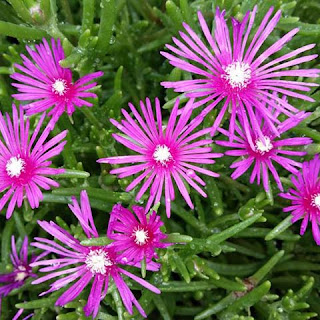 |
| Delosperma cooperi aka Ice Plant |
Q. Why is this called "Ice Plant"?
A. Delosperma cooperi is commonly known as Hardy Ice Plant. It's cold hardy into USDA Climate Zone 5. But its cold-hardiness is not the reason for the reference to ice. If you look closely at the slender foliage in the photograph above, you'll notice the glistening white surfaces. Upon examining with a magnifying lens, you'd see structures called epidermal bladder cells. These are what give Delosperma that ice-like glaze.
Incidentally, Hardy Ice Plant is also known as Mesembryanthemum cooperi. Mesembryanthemum is a genus that grows well in dry, salty, sandy environments. It thrives in South Africa, the Mediterranean region, parts of North and South America. Travelers along the Pacific Coast Highway 1 will see it often.
Ice Plant doesn't have to grow in sandy soil, but gardeners who have it, or who live in dry coastal areas will appreciate its abilities. It's an amazing little plant. To deal with heat, Ice Plant closes little pores (stomata) under its leaves to retain moisture. If it isn't getting enough salt, it takes up airborne saline through its foliage to retain moisture.
Mesembryanthemum leaves, flowers and seeds are edible. On top of that, the plant has medicinal qualities. It has been used to treat various ailments including liver, kidney and pneumonia. It is also used externally for skin treatment.
Hardy Ice Plant serves well as a ground cover in rock gardens, coastal and container gardens, succulent and cactus gardens, medicinal gardens, and xeriscapes. You should find a place for it in your garden.
Return to GoGardenNow.com.
 Delosperma is a delightful evergreen ground cover that only came to my attention within the last few years. It is a succulent, low-growing perennial plant that lends a fresh, cool appearance even during hot weather. These plants are becoming widely known mostly due to the work of Dr. Panayoti Kelaidis of the Denver Botanic Garden.

 Posts
All Comments