Thursday, October 22, 2020

Behind The Garden Wall - The Japanese Tea Garden - San Francisco


Finding Serenity


Azalea at San Francisco Japanese Tea Garden

Much of what you’ve heard about San Francisco, California is true. You’ll meet some friendly, helpful people. Its history is fascinating. Some streets are crazy steep, as are costs. Homelessness is rife. Human poop is on some sidewalks. Aimless, naked people might shout at you unprovoked. If you don't look down, the distant scenery is awesome, but you really should look down, occasionally.  

However, there are some lovely places where you can escape the insanity and find serenity. The Japanese Tea Garden San Francisco is one of them. It holds the distinction of being the oldest public Japanese Tea Garden in North America. 

Follow me to see what grows behind the garden wall.


Gate San Francisco Japanese Tea Garden


History

The San Francisco Tea Garden was originally an exhibit - one of many "villages" - spanning about one acre for the 1894 California Midwinter International Exposition. The Japanese Village and Tea Garden, as it was called, was conceived by George Turner Marsh of Mill Valley as a concession enterprise. The entry gate - Shuro-no-mon - actually came from Marsh's property.


George Turner Marsh portrait


Marsh was fascinated by all things Japanese, having lived there with his family as a teenager. As an "Orientalist", he opened the G. T. Marsh & Company store in San Francisco, featuring Japanese art and Asian-inspired jewelry. He also developed other Japanese gardens in California. The family-run store continued in business until 2001.

Marsh employed Toshio Aoki - an artist and designer in his studio - to design the garden. 


Japanese Village and Tea Garden 1894


The Japanese Village and Tea Garden was completed and opened on December 27, 1893, one month earlier than the Exposition's grand opening. For .25 cents, visitors could experience the "authentic" village with its story-teller, gates, buildings, bridge, restaurant, paths, lanterns, and landscape.

As the Exposition's closing neared, it seemed a shame to entirely dismantle the Tea Garden, so the Board of Park Commissioners paid $4,500 for it. Some structures were removed, a couple to Marsh's Mill Valley estate. The garden was closed for remodeling. Japanese businessman and gardening enthusiast - Makoto Hagiwara - was retained by a “gentlemen’s agreement” to create and maintain the permanent Japanese style garden.  

As caretaker of the property, Hagiwara spent many years and much expense developing it to its current size spanning about 5 acres.  He and his family lived there until 1942 when they were forced to leave their homes and go to internment camps. They were not allowed to return. Some of their possessions were moved to the home of a friend. Others were sold at auction, the proceeds of which were used as down-payment for another home in the Richmond District.

Features

The Japanese Tea Garden is now one of the most popular attractions in San Francisco. Noteworthy though typical features include a steeply arched drum bridge, stone lanterns and paths, pagodas, native Japanese plants, koi ponds and a zen garden.

Images

Visitors will enjoy scenes such as these.


San Francisco Japanese Tea Garden ferns

San Francisco Japanese Tea Garden - Koi

San Francisco Japanese Tea Garden - Tracery in the pines

Japanese Tea Garden San Francisco - Buddha

San Francisco Japanese Tea Garden - Iris pond


San Francisco Japanese Tea Garden - Lanterns

San Francisco Japanese Tea Garden - Drum Bridge

San Francisco Japanese Tea Garden - Pagoda

San Francisco Japanese Tea Garden - Paths

San Francisco Japanese Tea Garden - Stream

San Francisco Japanese Tea Garden - Tea House

San Francisco Japanese Tea Garden - Vista

San Francisco Japanese Tea Garden - Koi Pond and Lantern


Its Location, Admission and Cost

The Garden is located within Golden Gate Park at 75 Hagiwara Tea Garden Drive, San Francisco, CA 94118.

The attraction is now operated by the San Francisco Recreation and Park division, which has no intention of letting Japanese – or anyone else, for that matter – enter without paying admission, except for Monday, Wednesday, Friday from 9-10am, when admission is free. Find current hours. Find admission fees

Return to https://gogardennow.com.

Monday, October 12, 2020

Furry Puss Caterpillar - Cute But Dangerous


Puss caterpillar - Photograph by Donald W. Hall, University of Florida.
Puss Caterpillar - Photograph by Donald W. Hall, University of Florida.

It's oh-so-cute, but oh-so-dangerous - the Southern Flannel moth (Megalopyge opercularis), especially in its caterpillar form. The caterpillar looks kind of like a little pussycat, but it is not to be touched. The soft hair hides venomous spines. 

The severity of the sting depends a lot on the sensitivity of the individual and the thickness of the skin where it's stung. One first feels an intense burning sensation and a red grid-like pattern on the skin where the person is stung. But that may only be the beginning of it. Much more serious symptoms such as headache, fever, nausea, vomiting, rapid heart rate, low blood pressure, seizures and even abdominal pain, muscle spasms and convulsions can occur.

Who is most likely to encounter the Puss caterpillar? Children can certainly be stung. Its soft fur looks like it'd be fun to touch. Or, one might accidentally brush against it while walking in meadows or woods.

The Furry Puss caterpillar is found from New Jersey to Florida and westward to Arkansas and Texas. One year, its population in Texas grew to the point that school children were threatened and schools were closed.

Once the Furry Puss reaches the adult stage, the venomous spines disappear. At this point it's known as the Southern Flannel moth. It's still cute, but not to be welcomed.

By Patrick Coin (Patrick Coin) - Photograph taken by Patrick Coin, CC BY-SA 2.5, https://commons.wikimedia.org/w/index.php?curid=11740997

By Patrick Coin (Patrick Coin) - Photograph taken by Patrick Coin, CC BY-SA 2.5

If you live in this caterpillar's native range, be sure to warn your children of it, and take care yourself.

Wednesday, October 7, 2020

Nootkatone Is Now Registered By The EPA


The Environmental Protection Agency (EPA) announces, "A new active ingredient, discovered and developed by the Centers for Disease Control and Prevention (CDC), has been registered by the Environmental Protection Agency (EPA) for use in insecticides and insect repellents.

"Studies show that when products are formulated from the new ingredient, nootkatone, they may repel and kill ticks, mosquitoes, and a wide variety of other biting pests. Nootkatone is responsible for the characteristic smell and taste of grapefruit and is widely used in the fragrance industry to make perfumes and colognes. It is found in minute quantities in Alaska yellow cedar trees and grapefruit skin.

"Nootkatone can now be used to develop new insect repellents and insecticides for protecting people and pets. CDC’s licensed partner, Evolva, is in advanced discussions with leading pest control companies for possible commercial partnerships. Companies interested in developing brand name consumer products will be required to submit a registration package to EPA for review, and products could be commercially available as early as 2022."

When applied, it is able to repel ticks, mosquitoes, and other insects for hours. It is nontoxic to humans. Nootkatone is already used as an approved food additive, and is commonly used in products for human consumption.

Read more.


Tuesday, July 28, 2020

Residents Warned Not to Plant Unsolicited Foreign Seed Shipments

Photos of seeds sent to Virginians unsolicited/VDACS (Source: Virginia Department of Agriculture and Consumer Services)

Various news sources are warning residents not to plant any seed they receive unsolicited from unknown sources "because they could be a pathway for introduction of invasive species, insects and plant diseases." Apparently, these seed shipments are part of a massive international internet scam possibly originating from China.

If you live in North Carolina, Kentucky, Virginia or Georgia, you've probably seen this warning in the news. It seems to be making the rounds. I suspect, however, that the scam is not limited to those states. So let this be a warning to you.

For more information, check out the following sources:

https://vscnews.com/north-carolina-residents-plant-unsolicited-foreign-seeds/

https://www.vdacs.virginia.gov/press-releases-200724-seeds.shtml

Return to GoGardenNow.com.

Saturday, July 18, 2020

About The Cardinals


Northern Cardinal - Photo by Tina Nord from Pexels
Northern Cardinal


And how to attract them


When the word Cardinal is mentioned, four things come to mind – the bird, the baseball team, a church official and something of major significance. All of these converge in the bird.

The bird – crested and often clothed in bright red – is ubiquitous. Depending on the species, its range spans most of the United States, into Mexico and South America.

There are three perky species in the genus, two of which are common in North America.

Northern Cardinal - Cardinalis cardinalis


The Northern Cardinal male is crested, brilliant red with a black mask. The female is olive with a reddish cast. It’s so common, widespread and stunning that this species has been designated the official state bird of Illinois, Indiana, Kentucky, North Carolina, Ohio, Virginia, and West Virginia. It is not the state bird of Missouri.

Though the bird is figured in the logo of the St. Louis Cardinals baseball team, the team was not named for the bird, but for a color in their uniforms. That color – cardinal – is the shade of the cassocks of certain high-ranking officials in the Catholic Church. Important, indeed!

The Northern Cardinal ranges from Maine and Canada, throughout the eastern U.S., westward into Texas, into Mexico and as far south as Guatemala.

It feeds on fruits, seeds – particularly black oil sunflower – and insects, which its thick, sharp beak can dispatch in short order. These are easy enough to find.

The Northern Cardinal sometimes displays the curious behavior of pecking at glass and other shiny surfaces. This is because it’s very territorial, especially in spring. That reflected image of itself is taken to be a threat.


Pyrrhuloxia - Cardinalis sinuatus


The Pyrrhuloxia or Desert Cardinal is mostly found in the arid southwest and Mexico. It is also crested and resembles the Northern Cardinal, though the male is colored gray with a red mask, breast and crest. The female is gray sans mask.

Its diet also consists of insects, fruits – particularly cactus – and seeds.


Vermilion Cardinal - Cardinalis phoeniceus


By Félix Uribe, CC BY-SA 2.0, https://commons.wikimedia.org/w/index.php?curid=81342201

This one is quite similar to the Northern Cardinal with vibrant coloration and a more distinctive crest. It’s native only to the South American countries of Colombia and Venezuela. Since you won’t likely see it in your yard, you don’t need to worry about feeding it.


If you build it, they will come – certainly!


As noted before, cardinals are common in the United States. But they love to hide and nest in dense shrubbery. A good cardinal habitat will include a landscape of shrubs and low trees, seed-bearing grasses, flowers - particularly of the Asteraceae family.

Northern Cardinals are crazy about sunflower seeds, but they also eat cracked corn, safflower, peanut pieces, milo and millet. I love watching them adorn the winter branches of crape myrtles, devouring the seeds.

Pyrrhuloxia are fond of sunflowers and cracked corn. Bird-watchers in the Southwest should plant flowering, fruit-producing cacti.

If you really want to view them up close, seed feeders will surely draw them in. A vast selection of tray feeders, hoppers, tube feeders and ground feeders are for your choosing. However, if you’re a cat owner, or neighborhood cats visit you, skip the ground feeders.

Cardinals stand out in the crowd. Offer them attractive habitats, hiding places, water for bathing, their favorite foods, and you’ll be rewarded with a yard full of these delightful little creatures.

Return to GoGardenNow.com.

Thursday, June 25, 2020

About The Orioles


Orioles on Birds Choice Oriole Feeder

And how to attract them


For a type of blackbird, orioles are exceptionally colorful. Bright yellow, orange to chestnut colors contrast beautifully against black plumage punctuated with splashes of white. 

There are nine species native to North America – Baltimore Oriole (Icterus galbula), Orchard Oriole (Icterus spurius), Bullock’s Oriole (Icterus bullockii), Hooded Oriole (Icterus cucullatus), Scott's Oriole (Icterus parisorum), Audubon's Oriole (Icterus graduacauda), Altamira Oriole (Icterus gularis), Spot-breasted Oriole (Icterus pectoralis), and Streak-backed Oriole (Icterus pustulatus). Their ranges sometimes overlap, so it’s possible to observe one or more of them in your area.

Baltimore Oriole


The Baltimore Oriole is the most famous by far, if not for its abundance then certainly because of the Major League Baseball team that bears the name. But the bird was here first. They’re so named because their colors are similar to the heraldic crest of the Calvert family and Lord Baltimore, after whom Baltimore, Maryland is named. 

Its head is black, breast is orange, and white patches adorn the wings. As with many bird species, the difference between male and female colors is usually quite different – the males normally sporting brighter colors.

They range from eastern British Columbia to Nova Scotia, southward through Texas to Central America, Florida and Cuba. Their breeding range is from Canada to Louisiana, Alabama and Georgia. They overwinter in the warmest climates south of the U.S. border. In the United States, we’ll hear them early in spring high in the trees where they’re searching for insects and nesting materials. Their nests dangle from tree branches.

Orchard Oriole


The Orchard Oriole is slightly smaller than the Baltimore Oriole, and its range is a bit smaller, too. Nevertheless, it can be found in spring from southernmost Manitoba and Ontario, southward through Texas to Mexico, and eastward from Maryland to North Florida. 

Its head is black, and breast color is a darker chestnut. It lacks the large white wing patches of the Baltimore Oriole. 

It’s mostly found in shrubs and orchards, particularly near water sources. They hang around for a briefer period during breeding season – arriving in late spring and leaving by mid-summer. 

Bullock's Oriole


Bullock’s Oriole sojourns in the west. It ranges from southernmost Alberta and Saskatchewan to California, through Texas and into Mexico. They can be found in open woodlands, and shrubs and trees near water sources, which are especially needed in the arid southwest.

The crown of the head is black and bright orange with a black stripe across the eye. The breast is also orange. White patches and streaks adorn the wings.

Hooded Oriole


The Hooded Oriole ranges further west, from California to Nevada, southward through Texas and Mexico. They can also be found in open woodlands and yards, especially among palms from which they find nesting fibers. They actually hang their nests among the fronds to avoid detection.
Their wings, backs and tails are black, as are the lower half of their faces. Their breasts and heads range in color from bright yellow to bright orange. White streaks on their wings.

Scott's Oriole


Scott’s Oriole travels from southernmost Idaho and easternmost Nevada through Colorado, New Mexico, Arizona, Texas and into Mexico. It frequents deserts and mountain slopes, flitting and flirting among yuccas, pines, palms and junipers.

Scott’s Orioles have black heads, backs and wings streaked with white. Breasts and bellies are lemon-yellow.

Audubon's Oriole


Audubon’s Oriole is very much like the Scott’s Oriole, but does not have the black back. It’s doubtful that you’ll spy them very often. They live in southernmost Texas and in limited regions of Mexico. They’re rather shy creatures, searching among brush and woodlands for insects. If you see one, consider yourself lucky.

Altamira Oriole


The Altamira Oriole is another you’ll rarely see unless you live in the Texas Rio Grande region. Their heads are bright orange. They sport black masks and a black streak down the center of the breast. Backs, wings and tails are black with white streaks. 

Look for them in parks, open woodlands, and high branches in trees near water. As with other orioles, their nest can be seen dangling from heights.

Spot-breasted Oriole


Spot-breasted Orioles inhabit a very limited range in the United States in eastern Florida from Cape Canaveral to Miami, only because they were introduced there sometime after World War II. Otherwise, they’re native to the lower western coast of Mexico and into Central America.

They’ve become somewhat common in Florida. They look very much like the Altamira Oriole, but have black spots on the breast spreading toward the wings.

Streak-backed Oriole


Streak-backed Orioles visit the southwestern United States, but are mostly found in western Mexico and southward into Central America. It’s flame orange on its head, belly, breast and back. A black streak marks its breast and black streaks run down its back. Its tail is black. White streaks adorn its wings.

You may find them in arid grasslands, open woodlands and shrubs. They are very much attracted to various mimosa plants, which are rich in nectar, so homeowners in those areas would plant them to attract these avian gems.

Which brings us to the next subject.

How to attract orioles.


Photo credit: Lori Meehleder

If you build it, they will come...maybe.


It just so happens that most orioles are suckers for sweet fruits and nectar. Yes, they eat insects, but they  adore sugar.

Dark and brightly colored fruits, in particular, attract their attentions. Oranges, blackberries, raspberries, blue and purple grapes, plums, blackberries, raspberries, red cherries and crab apples will keep them coming back. You can provide them in feeders, or better still, plant a few shrubs and trees in your yard!

Split oranges in half and secure them on nails or dowels. Chop up pieces of apple to present in bowls or shallow cups. Do the same with grapes and berries. Would you like to provide an opulent feast? Put a few dollops of grape jelly in the bowls. 

Nectar rich flowers such as Trumpet Vine will entice them. Not only is the nectar sweet, but the color is just right, too – bright orange and red.

Those orioles that are native to the Southwest and South will also feed on yucca flowers. Yucca plants are very drought-tolerant, too. They’re perfect for xeriscaping, whether of necessity or simply to save on your water bill.

Since they’ll drop in to feed, why not provide the orioles with nesting materials. Oriole nests are complex things, sort of like dangling purses to hold their young. Fibrous plants will do the trick. Palms and yucca plants are very fibrous. Southerners should be able to grow them with ease. In colder regions, orioles will make good use of long grass blades, hair, threads and string, even plastic strips. Though it’s best not to leave plastic blowing around, it’s good to know that errant pieces can be used for good.

Orioles are certainly some of the most colorful bird species of North America, and they’re more interesting to birders because they don’t hang around very long in their breeding areas. So, be prepared for their coming in the spring. Purchase your oriole feeders, buy grape jelly (!), plant your fibers and save string for the next season so you can enjoy these exotic-looking creatures while they last.

Return to GoGardenNow.com.

Thursday, June 18, 2020

Great Plants For Your Rain Garden


Rain Garden


In an earlier blog article – How To Create A Rain Garden – we discussed an important element – rain garden planting zones. Here's what you need to know.

Divide your rain garden into zones, and select plants appropriate to each. Depending on the size of the garden, you might choose plants ranging in size from low ground covers to perennials, small or even large shrubs.

    • Zone 1 is the deepest where water will stand the longest. Plants for this area should be able to thrive in standing water for awhile.

    • Zone 2 is an intermediate area where water will stand for short periods, but drain away. It is just above and wraps around Zone 1. Plants for this area should be able to grow in wet or dry ground.

    • Zone 3 is the uppermost, wrapping around the other two, and will be the driest. Plants for this area should be able to withstand periods of dry weather.

Here are some plant suggestions for each zone.

Zone 1

  • Blue Sedge with its blue-green arching leaves is a perfect plant for that area where drainage is a problem. It's ideal for naturalizing, bog gardens, rain gardens, water gardens, container gardens, and erosion control. As a lawn substitute, it will tolerate some foot traffic. It's also deer resistant! Carex 'Bunny Blue'® is a very attractive variety.
  • Japanese Sweet Flag thrives in wetlands like along ponds, rain gardens or pools, and can even grow when submersed. It's one of the best grassy solutions for those problem areas with poorly drained soils.
  • Golden Creeping Jenny is an excellent ground cover solution for any size area. It's also successful in container gardens, hanging baskets, bog gardens and perennial borders. Because it tolerates some foot traffic, Lysimachia is perfect around patios and between stepping stones.
  • Mazus is a preferred ground cover for moist soils of any size area. Lush green leaves form a low, dense mat. Foliage is evergreen in warmer climates to semi-evergreen in cooler zones. Small, lavender or white flowers bloom from spring to summer.
  •  Mondo grass is tolerant of wet areas as well as dry. It’s deer resistant, and tolerates some foot traffic.
  • Royal Fern is a lovely native species that performs well in a wide range of climate zones. Light green fronds with burgundy-tinged edges emerge in spring, and turn medium green during the growing season. In fall, fronds turn yellow shades. Royal fern is clump-forming. Mature height is 24 inches to 60 inches. Foliage is dormant in winter. Royal fern is deer resistant.

Zone 2

  • Appalachian Sedge is a graceful plant, native to the Eastern U.S. It has very fine, dark green, weeping blades, 12" long.  The leaf blades are evergreen in warmer climates. It has a clumping habit, and spreads slowly, making it suitable for borders. It's a great ground cover and lawn-grass substitute in dry shade.
  • Creeping Lily Turf is a choice plant for a low maintenance ground cover in sun or shade. Evergreen foliage forms a dense, grassy covering that tolerates foot traffic, making it a fine lawn grass substitute, especially for those areas you'd prefer not to mow. It can take a period of wet weather, as well as drought.
  • Blue Star Creeper is amazing. It tolerates a wide variety of soil conditions – wet or dry. If you're looking for a low-maintenance, low-profile, quickly growing ground cover with a long bloom season, consider Blue Star Creeper. Use it where you want a low-maintenance cover at a distance from high-traffic areas.
  • Mondo grass, as mentioned above, is tolerant of a wide range of soil conditions. If you need a low-maintenance, lush, evergreen grass substitute for full sun to shade that tolerates a wide range of soil conditions, we highly recommend Mondo.
  • Pennsylvania Sedge is a fine native plant choice for dry shade.  Use it for naturalizing, and erosion control. Pennsylvania sedge is deer resistant, too.

Zone 3

  • Achillea – Yarrow. Achillea has long-lasting flowers, is drought-tolerant, repels pests, and is aromatic.
  • Ajuga – Bugleweed. Ajuga is a drought-tolerant evergreen plant prized for its dynamic color that stays compact and thick year round.
  • Asiatic Jasmine is a very desirable for ground cover and borders in warmer climates. It can be neatly edged for a manicured appearance. Asiatic Jasmine thrives in sun or shade, suppresses weeds, and resists hungry deer. Its dense habit will slow any rapid flow of water.
  • Appalachian Sedge is mentioned above. It’s a fine plant for Zone 3 also.
  • Black-eye Susan attracts butterflies. Birds get enthusiastic about the seeds. All varieties are reasonably drought-tolerant. They're especially suited to naturalizing, wildflower meadows, cutting gardens, wildlife gardens, native plant collections, heritage and cottage gardens. But they're wonderful in any perennial garden or border.
  • Blue Pacific Juniper is an excellent ground cover solution for medium to large coastal gardens. It thrives in dry, sandy soils, is salt tolerant, and is very effective for erosion control. It's deer resistant, too!
  • Coneflower is a tough and ever-popular addition to any perennial garden. Echinacea is loved around the world for its beautiful, showy flowers and reputed herbal remedies. It’s an ideal native plant for the dry area around the rain garden. If only all our plants could be so useful.
  • Coreopsis is a bright-flowered plant with blossoms shaped like large asters. It does well in dry areas, and is well-suited to wildlfower gardens. Coreopsis is native to the U.S., and, thankfully, its ornamental value is widely appreciated.
  • Pennsylvania Sedge is mentioned above. It is a good choice for Zone 3, also.

These are not exhaustive lists of plants suitable plants for rain gardens. But, with these plants to choose from, you can certainly create a lovely, low-maintenance, and sustainable rain garden.

Thursday, June 11, 2020

How To Create A Rain Garden


Photo by Markus Spiske from Pexels


Ahhh. Hear the pitter-patter of little raindrops on the roof and window panes. What a relief. But sometimes it becomes a torrent and puddles around the door. Eventually it flows down the street. Maybe not so good.

Much of the runoff doesn’t stay where it belongs – in the soil. It can damage your home by collecting around the foundation, undermining it, or flooding the basement. It can create a problem for the environment by washing pollutants into nearby lakes, rivers and watersheds. The rapid flow of water can contribute to flooding downhill. Perhaps it’s time to act. A rain garden might be your best solution.

What, exactly, is a rain garden?


A rain garden is a good-sized depression in the soil that’s created on sloping ground to catch the water as it flows and hold it, allowing it to soak into the soil.  It’s planted with different plant species – often native – that thrive in the various conditions created by the garden. The plants hold soil in place and  preventing erosion. Their roots absorb water, as well. Pollutants may be neutralized or dissipated.


What size and shape is a rain garden?


The size of your rain garden depends on your landscape and what it will accommodate. It should cover at least 100 sq. feet – best if it’s larger. But if there’s not enough room for that, a smaller one will do; it’s better than nothing.

The depth also depends upon your conditions. It shouldn’t be deep enough to form a perpetual pond, but not so shallow that water flows in and out in a flash – flood, that is. About 4 inches to 10 inches deep should be about right.

Abrupt angles are difficult to maintain, and not particularly appealing. A simple kidney-shape or something similar with gentle curves is desirable and popular.

Where should I create my rain garden?


The best place to create your rain garden is in the path of the downward water flow. You can learn this by observation. There are other situations to consider, too, like foot traffic. It’s best to avoid places where someone might step into it, trip and fall.

Make sure you don’t site it where you’ll encounter utilities, underground cables, or a septic drain field as you dig. More about that next.

How do I create my rain garden?


Call 811 – the national call-before-you-dig phone number. As their website states, “Anyone who plans to dig should call 811 or go to their state 811 center's website before digging to request that the approximate location of buried utilities be marked with paint or flags so that you don't unintentionally dig into an underground utility line.” Then wait for their people to show up. Be patient. Even when the lines are supposedly marked, dig with caution. Cable television lines, especially, are notoriously shallow.

Mark the chosen site in the desired shape. Lay out a flexible garden hose around the garden’s perimeter. It’s temporary, and can be moved about until you’re satisfied with the shape. You may also mark the area with flags or orange spray paint.

Cut the grass short, then remove the sod inside the perimeter with a spade. Better still, rent a sod-cutting machine. Recycle the sod to cover bare spots elsewhere in your lawn.

Dig to the desired depth with gently sloping sides. The deepest level should be near the lower end with a flat base about 24 inches or more across. This will provide a place for some plants to grow, and allow water to percolate downward evenly.

Test the soil pH. You can obtain a soil sample bag from your nearest Cooperative Extension Service office. Follow instructions. Return the sample to the office, and pay a nominal fee. You should receive the results in a couple of weeks.

Amend the site, if necessary. You might need to adjust the pH according to the soil test recommendations.

Test the water absorption rate. Add a few measured inches of water to the site. If the soil is packed hard so that water doesn’t infiltrate quickly – about ½ inch per hour – you’ll need to break through the hardpan using a method called “double-digging.” You might need to add sand, milled sphagnum or compost – mixing well – to enhance the “structure” making it suitable for plant growth, and to improve the “permeability” of your native soil.

Divide your rain garden into zones, and select plants appropriate to each. Depending on the size of the garden, you might choose plants ranging in size from low ground covers to perennials, small or even large shrubs.

    • Zone 1 is the deepest where water will stand the longest. Plants for this area should be able to thrive in standing water for awhile.
    • Zone 2 is an intermediate area where water will stand for short periods, but drain away. It is just above and wraps around Zone 1. Plants for this area should be able to grow in wet or dry ground.
    • Zone 3 is the uppermost, wrapping around the other two, and will be the driest. Plants for this area should be able to withstand periods of dry weather.

Install your plants according to best practices appropriate to each species. Helpful information should be available on plant labels, from garden center staff, books, magazine and online sources such as our GoGardenNow plant catalog, and here at GoGardenNow – The Gardening Blog.

Mulch will not be necessary. Rainwater will be flowing down into the rain garden, and will wash the mulch right along with it making quite a mess. Lawn grass or ground cover perennials should stabilize the slopes around the edges quite well.

Maintain your garden during the early stages with adequate irrigation. This will help your plants to become established and get a good start. Fertilizer may not be needed, especially if compost was incorporated into the soil during site preparation.

Final thought


Enjoy your rain garden knowing that it will help prevent water runoff damage to your home, landscape and even distant watersheds. In addition, it will add interest and value to your property. 

Friday, June 5, 2020

How To Create An Indoor Garden


Bring some of the color, texture and fragrance of the outdoors into your home or workspace with an indoor garden. Here are some of the whats, whys and hows you’ll need to know to get started with houseplants.


An indoor garden is a collection of plants that you grow in suitable containers in an enclosed space, usually in your home. But you can also have one in your workspace. It may be small, consisting of an African violet or two on your desk, or an array of plants of many species in various sizes and shapes.

Why should you have an indoor garden?


There are many good reasons. Indoor flowering plants add a touch of cheer to any room. Indoor foliage plants lend warmth and style. A few herbs in the kitchen window provide a few flavorful snips for your culinary creations. All green plants help to clean the air, even if only a little.

What types of plants can you grow in an indoor garden?


In most cases, you should choose plants that thrive in low-light conditions, or that will grow under artificial lighting. They should be relatively small, appropriate to the space available, keeping in mind the possible size at maturity. You don’t want a plant that will outgrow its welcome.

From there on, the possibilities are many. Kitchen herbs, cacti and succulents, perennials, annuals, ferns, bulbs, flowering shrubs, dwarf trees, vines and tropical plants are all good choices.

How should you begin?


Start by deciding what types of plants suit your fancy, then gather the appropriate materials. Peruse books or magazines to see what appeals to you. Browse your local garden center. Pay a visit to your friends and neighbors.

What supplies will you need?


Generally, you’ll need the following:

Suitable growing containers

Containers come in various sizes, shapes and designs for just about any type plant you choose. African violets, for example, do well in small ceramic pots-in-pots with irrigation ports, or wicking functions. Orchid pots or baskets will have openings that allow ventilation around the roots. Cacti and succulent containers will allow quick drainage. And, of course, you’ll need saucers to prevent water from dripping on your floor.

Potting soil

In most cases, a premium grade of organic, sphagnum-based potting soil will be fine. Some come with vermiculite, perlite and fertilizer additives. Avoid cheap “topsoil” mixes. Orchid mixes will contain bark or osmunda fibers to allow for air circulation. Soils for cacti and succulents will contain sand for drainage.

Appropriate hand tools

A basic set will include a small trowel, garden fork, watering can or mister, plant clippers and garden gloves. Various plants with special needs will have tools designed especially for them. Be sure to purchase good quality tools, not cheap toys. I’ve heard it said before – and I totally agree – that you can cry once when you buy them, or you can cry twice when you buy them and when they break.

Plants

The choice is entirely yours considering your space, interests and available time. Don’t be surprised, though, if you begin to collect particular types as your interest is piqued.

Light

You might need a light source – possibly a “grow-light” fixture – if window lighting is insufficient. These should provide “full spectrum” lighting to replicate sunlight. They may be florescent tubes, bulbs, or LED types. These are usually set just a few inches above your chosen plants. You should be able to find a wide selection online or in “brick-and-mortar” garden shops.

What next?


As you begin growing, you should learn a few basics about your chosen plants. Our Gardening Resources page at GoGardenNow.com provides summaries of a large number of organizations, plant societies and clubs where you can find all the information you’ll ever need. In addition, you’ll probably meet and correspond with folks having similar interests who are willing to share their tips with you.

So, go on. Get started. Have fun!

Return to GoGardenNow.com.

Tuesday, June 2, 2020

Upstairs or Downstairs, Indoors or Outdoors


Photo by Huy Phan from Pexels

Plants for those spaces

Indoor plants are wonderful. Houseplants brighten any room, add a little color, clean the air, and lend a touch of elegance. What’s not to love? Wouldn’t it be great, though, if you could move them about from indoors to the outdoors, and back again any time of year?  You could enjoy a little variety in your dĂ©cor, and freshen the look of your garden at will.

Unfortunately, most of those sold as indoor plants are native to the tropics, or their ancestors were. They’re simply not suited to growing outdoors in temperate climates. There are, however, very many species that thrive indoors, and are hardy enough to be moved outdoors to the garden, patio or deck. Here are a few to consider:


Carex laxiculmis 'Hobb'

Carex ‘Bunny Blue®’ 

Carex laxiculmis 'Hobb – Bunny Blue® Sedge – is native to Eastern North America. Foliage is evergreen when grown indoors, outdoors in warmer climates and semi-evergreen in the northern states.  This beauty has graceful, arching blue-green to blue-gray foliage, 1/2" wide, 12"-14" long.  Carex Bunny Blue® grows in clumps and spreads slowly to 12"-15" across.  Flowers are yellow but insignificant, and appear in late Spring.  Bunny Blue® will grow in average potting soil, with adequate irrigation, but really thrives in moist to wet soil. You can’t over-water it! Grow it outdoors in USDA climate zones 5-9.


Creeping Fig

Creeping Fig

Creeping Fig – Ficus pumila – is an elegant vine that excels in container gardens, hanging baskets, and topiaries. Evergreen foliage makes it a lovely subject year around. Creeping Fig is hardy in USDA climate zones 8-11.


Christmas Fern


Christmas Fern

Christmas FernPolystichum acrosticoides – is a native, evergreen beauty that brightens the winter landscape with its glossy deep green fronds. For generations fronds were cut and gathered in winter to decorate the home for Thanksgiving and Christmas. Christmas Fern thrives when grown indoors in potting soil with adequate watering, so you can decorate your home for the holidays any time of year. Grow it outdoors in USDA climate zones 3-9.


Hedera helix 'Ivalace'

Ivalace Ivy

Hedera helix ‘Ivalace’! With its curly leaves and compact habit, the American Ivy Society gave it the 2011 Ivy of The Year Award. Despite its beautiful appearance, it's tough. It's great as an indoor houseplant, useful in container gardens, topiaries, and even as a ground cover for small areas outdoors. It’s hardy in USDA climate zones 5-10. If you want an ivy with more vigor, any of the other varieties of Hedera will perform well indoors and out.


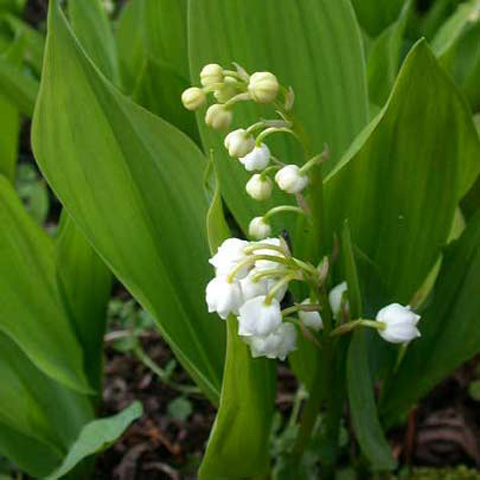
Lily-of-the-Valley

Lily-of-the-Valley

Lily-Of-The-ValleyConvallaria majalis – is very easy to grow from bare-root rhizome divisions. Fragrant, bell-shaped flowers perfume the indoors. It is effective in container gardens, fragrance gardens, and naturalized outdoors in shade gardens and woodland settings. When the outdoor site is to its liking, Lily-Of-The-Valley spreads rapidly. Lily-of-the-Valley is hardy outdoors in USDA climate zones 4-8.

Liriope muscari 'Christmas Tree'

Liriope

Oh, my! There are so many varieties of Liriope muscari to choose from. I prefer the ones with deep green foliage and larger flower spikes for indoor gardens. Those with variegated foliage sometimes lose their color contrast in shady areas. Liriope graces the home with tall, blade-like leaves, adding some height and a nice texture to containers of mixed species. Liriope is generally hardy in USDA climate zones 5-11.


Dwarf Mondo

Mondo

My favorite mondo for container gardens is Ophiopogon japonicus ‘Nana’, or Dwarf Mondo. Short, evergreen blades have the appearance of turf-grass. It thrives in shade. It’s sometimes used as a bonsai subject, or in containers with larger specimens. Mondo is hardy outdoors in USDA climate zones 6-10.

Return to GoGardenNow.com.

Wednesday, May 20, 2020

Have you considered growing a pollinator garden?


Photo by Ersin Aslan from Pexels


Have you ever considered making a place in your landscape specifically for native pollinators? Doing so can help preserve those that are struggling to exist. You might not think of pollinators such as bees,  wasps and butterflies as being under threat, but many are. We usually blame overuse of insecticides as being the culprit, but there are others. Diseases, parasites and predators take their toll. By providing a pollinator-friendly habitat, you help them thrive, as well as enjoy their presence. You also gain a sense of pride in doing good for the environment.

You don't need much space to establish a pollinator garden. A few plants on your deck or patio can attract them. If you have a large area available, by all means, use it.

Pollinators have three basic needs, common even to you and me - food, water, and shelter for places to hide and begin their little families.

Food Sources - Host Plants

We picture bees and butterflies feeding on nectar from flowers, but juvenile pollinators don't do that. Young ones feed on stems and foliage, and not always of the same plants. Proper food supplies should include both.

To determine exactly which you'll need to plant may require a bit of study on your part. Good plants for pollinators include aromatic herbs, annuals, perennials, and even some weeds. GoGardenNow.com features plant collections for butterflies and other pollinators. Plant a wide variety. Select species that will provide blooms throughout the growing season. Research the species of pollinators commonly found in your area, then provide the foods they enjoy.

Remember that native pollinators often prefer native plants, so be sure to include some in or around your garden. It's not a good idea to gather plants from the wild. Some may be endangered and protected. Sow seed where possible. For mature plants, search for those nurseries that specialize in native species. There are a growing number of them. Native Plant societies can help you find sources.

Water

Pollinators need water. You'll often find bees gathered along the edges of bird baths. Butterflies will cluster around mud puddles, birdbaths, and even dung. Be sure to provide water sources for them. Still, shallow water is best. You needn't provide the dung.

Shelter, Nesting Sites and Materials

You'd be surprised at how resourceful little creatures can be when it comes to establishing homes.


That aside, pollinators will burrow in plant stems, hide in flower pots, small brush piles, and even nest in bundled drinking straws. Dryer lint, cotton balls, and the mud from puddles will be used for building materials.

After providing for your pollinators' needs, please be careful not to lure them to destruction. By that I mean, avoid using pesticides and herbicides in or around your pollinator garden. Both organic and synthetic pesticides can be harmful. Herbicides can kill the very plants you provided for pollinators' benefit.

Pollinator gardens fascinate young and old, but especially the young. Remember how enthralled you were as a child while watching butterflies and bees? Pass the feeling along to your own children, grandchildren, or even to kids in the neighborhood. You and they will be delighted that you did.

Return to GoGardenNow.com.


Sunday, May 3, 2020

Life Stages of Butterflies, and Plants to Attract Them.


Tiger swallowtail utterfly on lantana


If there were beauty contests for insects, adult butterflies would win every time. But their time spent in glamorous array is incredibly short – usually for only a few weeks. The rest of their lives are spent in less dramatic forms: egg, caterpillar, and chrysalis.

“The caterpillar does all the work, but the butterfly gets all the publicity.”
― George Carlin


Butterfly eggs are laid by adult female butterflies on plants, but not just any plants. The plants, known as “host plants”, are chosen for their desirability as food for the caterpillars which eventually emerge from the eggs. Which are desirable? They choose those they are accustomed to by their very nature, usually the ones endemic or similar to those found in the caterpillars’ native habitats.

Butterfly chrysalisAfter the eggs hatch, the caterpillars eat, and eat, and eat a lot more. Gardeners who have had their cole crops decimated by cabbageworms know it well. They gorge themselves because they are preparing for the next stage of their lives sequestered in the chrysalis. The chrysalis looks sort of like a sarcophagus. It is within the chrysalis that the caterpillar changes into a butterfly. It’s for that reason, I think, that the butterfly’s emergence is compared to resurrection from the dead.

After the metamorphosis, the adult butterfly feeds on fruits or flower nectar. These may be the same as the host plant, or many others.

When planting a butterfly garden, be sure to include species that are native to your area. While non-native species might be visually appealing to you, your butterflies might turn up their proboscises at them.

To help you select plants for your butterflies, we at GoGardenNow.com have created a category of plants that attract butterflies. Some serve as host plants; some serve as food plants. You should include both in your garden. Not only that, but we’ve listed specific butterfly species known to be attracted to each of the plants in the category.

Zebra Heliconian butterfly on lantana
For example, if you go to the Lantana listing, you'll read, "Attracted species include Spicebush Swallowtail, Zebra Heliconian, American Lady, Cabbage White, Clouded Skipper, Fiery Skipper, Dun Skipper, Crossline Skipper, Eufala Skipper, Least Skipper, Ocola Skipper, Pecks Skipper, Zabulon Skipper, Tawny-edged Skipper, Silver-Spotted Skipper, Orange Sulphur, Clouded Sulphur, Pipevine Swallowtail, Zebra Swallowtail, Eastern Tiger Swallowtail, Black Swallowtail, Gray Hairstreak, Red-Banded Hairstreak, Great Southern White, Variegated Fritillary, Great Spangled Fritillary, Hayhurst’s Scallopwing, Horace’s Duskywing, Wild Indigo Duskywing, Little Glassywing, Monarch, Painted Lady, Pearl Crescent, Sachem, Silvery Checkerspot."

The lists are not exhaustive, but should be helpful.

If you have a certain butterfly in mind that you want to feed, simply go to the Home Page, enter your butterfly name, and Search. A list of particular plants will pop up. For example, enter the word “monarch”, and this list will appear.

Finch on Echinacea seeds
When your garden is filled with your local butterflies’ favorite foods, you’ll have a lovely display of flowers and butterflies, too. But there could be an added bonus - birds! Yes, many of the same flowers attract birds, as well. Echinacea, for example, attracts a whole host of butterflies, and the flowers gone to seed feed the birds. So, let the seed-heads mature for the birds.

As your garden appeals to birds and butterflies, you’ll help support both, and enjoy your beautiful guests.

Return to GoGardenNow.com.